
CISI Fundamentals of Financial Services
Welcome to your comprehensive study suite for the CISI Fundamentals of Financial Services exam. Structured exactly according to the 30-question, 1-hour exam format.
Preview & See What You Will Get
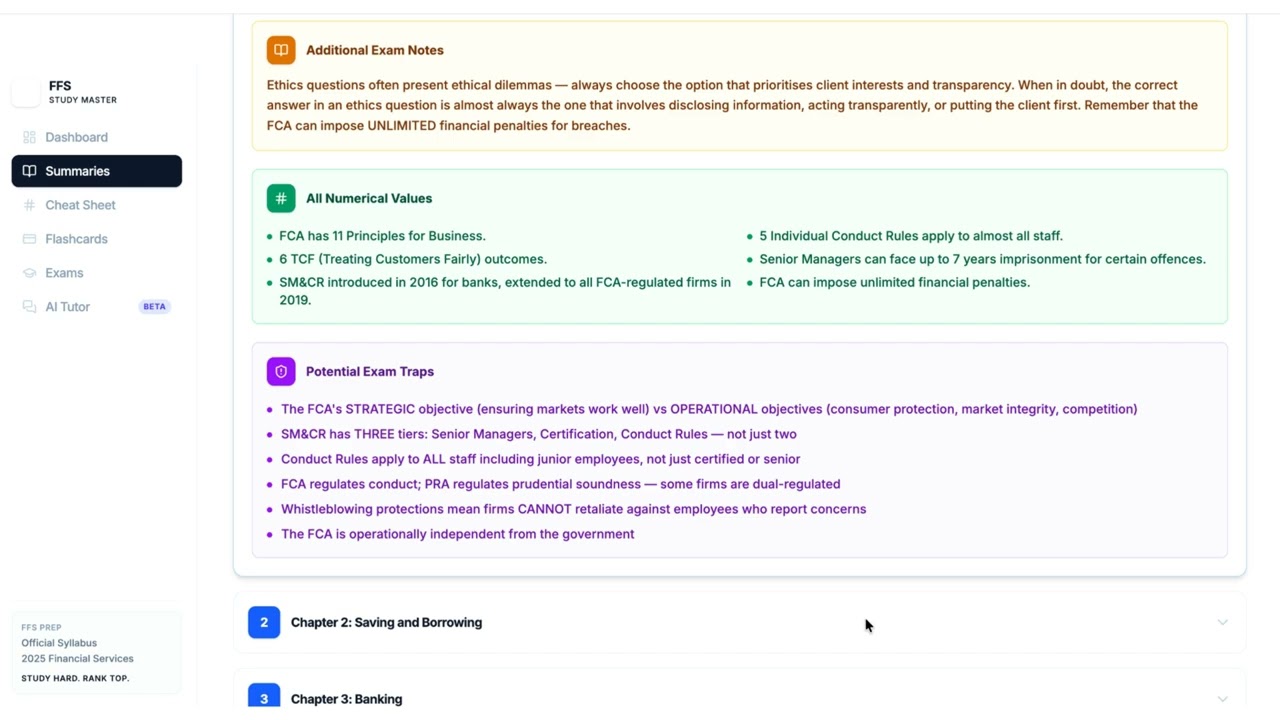
CISI Fundamentals of Financial Services with Smart Practice
This is more than just a study guide. It’s a comprehensive exam mastery system designed to give you a rock-solid foundation for the Fundamentals of Financial Services.
We've transformed the latest syllabus into a dynamic, interactive learning experience. No more wading through dense textbooks - our system focuses on the core examinable concepts you need to pass your exam with confidence.
Key Benefits
Official Mock Simulators
Select a specialized paper to test your knowledge. Each paper consists of 30 questions to be completed within 60 minutes.
- ✓ Balanced Exam: The standard CISI-style simulation. Reflects official chapter weightings across the entire syllabus.
- ✓ Scenario Heavy: Focuses on application and scenario-based questions.
- ✓ Technical Precision: Tricky details and calculation focus. Targets interest rates, formulas, and fine regulatory distinctions.
Active-Recall Flashcards
Memorize key facts, definitions, and thresholds faster using digital flashcards.
- ✓ Designed for quick revision on any device.
- ✓ Focuses on 'Must Memorise' exam content.
- ✓ Optimized for long-term retention.
AI Study Tutor
Your personal tutor, available 24/7 to explain complex financial concepts.
- ✓ Instant clarification of jargon and rules.
- ✓ Simplified explanations of regulatory factors.
- ✓ Personalized breakthroughs for high-level concepts.
High-Yield Cheat Sheets
The 'Final Hour' Revision Guide: Core Formulas, Regulatory Logic, and Key Timelines.
- ✓ Rapid review of regulatory timelines.
- ✓ Quick-reference for regulatory thresholds.
- ✓ Perfect for final revision before the test.
Who Is This For?
Frequently Asked Questions
Syllabus
Module 1: Ethics and Integrity in Financial Services
Explores the fundamental principles of ethical behavior in the financial sector.
- • Trust is the primary asset; once lost, the system collapses.
- • Ethics vs Regulation: Legal is the floor (minimum), Ethics is the ceiling (excellence).
- • Principles-Based Regulation: Focuses on outcomes rather than rigid check-boxes.
- • Conflicts of Interest: Must be identified, managed, or disclosed.
- • Whistleblowing: A protected way to report unethical behavior.
Module 2: Saving and Borrowing
Covers the link between savers (surplus) and borrowers (deficit).
- • Intermediation: Banks take many small deposits to make fewer large loans.
- • Real Rate of Interest: Nominal Rate minus Inflation Rate.
- • Liquidity: Instant access accounts have high liquidity but lower interest.
- • Secured vs Unsecured: Secured debt (mortgages) has lower interest rates due to lower risk to the lender.
- • Credit Unions: Mutual organizations where members are also owners.
Module 3: Banking
Details the functions of retail, commercial, investment, and central banks.
- • Retail: Focuses on mortgages, loans, and credit cards for the public.
- • Investment: Underwrites share issues and advises on corporate takeovers.
- • Central Bank: Manages the national debt and the money supply.
- • FSCS: Protects depositors if a bank fails (£85k per person/firm).
- • Payment Systems: CHAPS is for urgent, large amounts; BACS is for salaries/direct debits.
Module 4: Equities
Shares representing ownership in a company.
- • Ordinary Shares: Carry full voting rights and variable dividends.
- • Preference Shares: Fixed dividend, no voting rights, paid before ordinary shares.
- • Dividend Yield: The annual return from dividends relative to the share price.
- • Corporate Actions: Rights Issues (dilution) and Scrip Dividends (receiving shares instead of cash).
- • Capital Gains: The profit made from selling an asset for more than its purchase price.
Module 5: Bonds
Debt instruments (IOUs) issued by governments or companies.
- • Coupon: The interest rate stated on a bond when it's issued.
- • Maturity: The date on which the principal amount of a bond is to be paid in full.
- • Inverse Law: If market interest rates rise, bond prices fall.
- • Flat Yield: Annual Coupon divided by the Market Price.
- • Credit Spread: The difference in yield between a government bond and a corporate bond of the same maturity.
Module 6: Derivatives
Financial instruments whose value is derived from an underlying asset.
- • Futures: Legally binding obligation for both parties.
- • Options: Holder has the right; Writer has the obligation.
- • Hedging: Offsetting risk in an underlying asset.
- • Margin: A deposit required to maintain a derivatives position.
- • Mark-to-Market: Daily adjustment of a margin account based on price changes.
Module 7: Markets
Collective investment schemes like OEICs and Unit Trusts.
- • Diversification: 'Don't put all your eggs in one basket.'
- • Open-Ended: Fund size grows or shrinks based on investor demand.
- • Closed-Ended: Fund size is fixed; price is determined by supply and demand on an exchange.
- • Gearing: Borrowing money to increase investment exposure (unique to Closed-Ended).
- • NAV (Net Asset Value): Total value of fund assets divided by number of units/shares.
Module 8: Other Areas of Financial Services
The rules and bodies governing the financial industry.
- • FCA Statutory Objectives: Protect consumers, protect financial markets, promote competition.
- • PRA Focus: Ensuring banks and insurers have enough capital to stay solvent.
- • AML Stages: Placement -> Layering -> Integration.
- • Insider Dealing: Using price-sensitive, non-public info to trade.
- • Suitability: Ensuring a financial product is appropriate for a client's needs and risk appetite.
CISI Fundamentals of Financial Services
By enrolling, you agree to our Terms & Conditions
Course Features
Student Reviews
Verified purchases from actual professionals preparing for their CISI exams.
Recent Reviews
Fintech regulation up to date
"Open banking, PSD2 implications, and digital payment innovation — topics that are increasingly featured in exams."
Risk categories made practical
"Operational, strategic, and reputational risks are taught with case studies that make abstract concepts concrete."
Strong foundation built
"As someone transitioning into finance, this course gave me the fundamental knowledge I needed. The flashcards are perfect for memorizing key concepts."
Ethical standards well covered
"Treating Customers Fairly and the FCA 6 outcomes — important principles that are likely exam questions."
Fast-track preparation
"I needed to pass quickly for a job offer. Studied for 10 days using this and passed comfortably."
Financial Services Fundamentals
"Perfect entry-level prep. The active recall flashcards made the basics stick instantly."
Ready to Pass Your Exam?
Join hundreds of finance professionals who passed their CISI exams and earned their CISI qualifications with our smart practice platform and AI CISI tutors.