
Table of Contents
- • Why this update matters
- • POATR in plain language
- • What PRM does
- • Regulated markets and primary MTFs
- • Secondary issuance thresholds
- • How to revise the addendum
- • Connect the update to the full exam
- • Avoid three common mistakes
- - 1. Treating an old workbook as the final authority
- - 2. Memorising acronyms without the decision path
- - 3. Mixing the full certificate with this unit
- • Conclusion
CISI Corporate Finance Regulation
Explore syllabus-aligned study tools, realistic practice and course-grounded AI support.
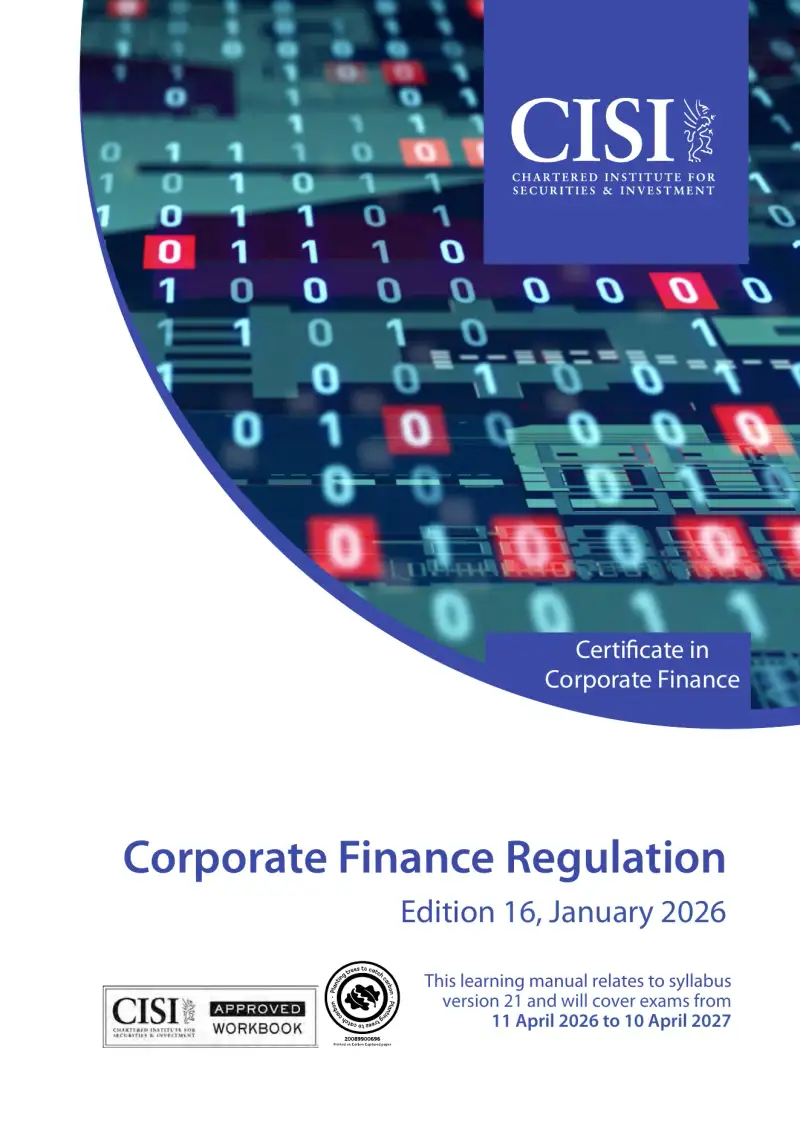
The March 2026 candidate update is essential for anyone preparing CISI Corporate Finance Regulation Version 21. It changes how candidates should understand the UK public-offers and admissions regime and supersedes affected material in an earlier workbook.
Quick answer: candidates need to recognise the roles of POATR, the FCA’s PRM sourcebook, regulated-market admissions and primary MTF prospectuses. Do not revise the replaced Chapter 2 text as if it were still the complete current framework.
Why this update matters
Corporate Finance Regulation is a 50-question exam. Element 2, Managing Regulatory Obligations, carries 16 questions—the largest share of the paper. The March 2026 addendum changes part of the rules studied within that high-weight element.
The correct approach is not to add the new terms to the margin of an old summary. Replace the affected logic so that your notes follow the current hierarchy and terminology.
POATR in plain language
POATR refers to the Public Offers and Admissions to Trading Regulations. The framework separates questions that older study material could blur together:
- Is there a public offer?
- Is a security being admitted to trading?
- On which type of market is admission sought?
- Which document or exemption applies?
- Which authority or market operator has responsibility?
For exam purposes, run two separate tests before choosing a disclosure requirement: whether the communication or transaction is a public offer, and whether securities are being admitted to a particular venue. An exemption from the public-offer route does not by itself answer the admission question.
What PRM does
PRM is the FCA sourcebook for Prospectus Rules: Admission to Trading on a Regulated Market. It sits within the revised framework for admissions to a regulated market.
Candidates should avoid assuming that every capital-raising event uses the same route. A public offer, a regulated-market admission and admission to a primary multilateral trading facility can involve different responsibilities and documents.
Regulated markets and primary MTFs
The candidate update also requires attention to primary MTF prospectuses. Build a comparison table with at least these dimensions:
| Question | Regulated-market route | Primary-MTF route |
|---|---|---|
| What event triggers the analysis? | Admission to regulated-market trading | Admission to a primary MTF |
| Where are the relevant rules located? | FCA PRM framework | Primary-MTF rules and prospectus framework |
| Who sets or applies detailed requirements? | FCA within its statutory remit | Relevant market operator within the framework |
| What should the candidate identify first? | Security, admission and exemption facts | Venue, offer/admission facts and operator rules |
The table is a revision framework, not a substitute for the official text. Populate it from the learning objectives and addendum applicable to your examination.
Secondary issuance thresholds
The update also affects how candidates revise secondary issuances and related thresholds. Numerical rules are particularly vulnerable to becoming outdated. Keep every threshold in a dedicated update sheet with its source and effective date rather than embedding it in an undated set of notes.
How to revise the addendum
- Mark every affected page in the workbook.
- Cross out or archive superseded notes rather than leaving both versions active.
- Rewrite each changed learning objective as a question.
- Build comparison tables for offer, admission, venue, document and authority.
- Practise short scenarios that change only one fact at a time.
- Recheck the official candidate-update page in the final week.
Connect the update to the full exam
POATR and PRM are important, but Version 21 still covers five elements:
| Element | Questions |
|---|---|
| The Regulatory Environment in the UK | 14 |
| Managing Regulatory Obligations | 16 |
| Corporate Governance | 5 |
| Takeovers and Mergers | 7 |
| Equity Capital Markets | 8 |
The updated admissions regime connects Elements 2 and 5. When studying an equity-capital-markets scenario, ask not only what transaction occurs but also which regulatory obligation and disclosure route follows.
Avoid three common mistakes
1. Treating an old workbook as the final authority
The examination follows the current syllabus and official candidate updates. An earlier print date does not override a later addendum.
2. Memorising acronyms without the decision path
Knowing what POATR and PRM stand for is insufficient. Practise identifying the offer, admission, venue and applicable rule set.
3. Mixing the full certificate with this unit
Corporate Finance Regulation is one unit of the Certificate in Corporate Finance. Corporate Finance Technical Foundations is the other unit. Keep their syllabi and practice records separate.
Read the official March 2026 candidate-update addendum alongside the latest CISI candidate-update page.
The Corporate Finance Regulation Version 21 preparation page reflects the five current elements and the March 2026 update.
Conclusion
The safest revision method is replacement, not accumulation. Update the affected Chapter 2 notes, build a clear decision tree for offers and admissions, and connect the new framework to the wider 50-question specification.
Frequently Asked Questions
1 What changed in the March 2026 Corporate Finance Regulation update?
The candidate update replaced affected Chapter 2 material with the Public Offers and Admissions to Trading Regime, the FCA PRM sourcebook and related primary-market changes.
2 What does POATR stand for?
POATR means the Public Offers and Admissions to Trading Regulations. It is part of the revised UK framework for public offers and admissions to trading.
3 What is PRM?
PRM is the FCA Prospectus Rules: Admission to Trading on a Regulated Market sourcebook used within the revised admissions framework.
4 Does an older Version 21 workbook automatically include the update?
Not necessarily. Candidates should apply the official March 2026 addendum to the affected pages and learning objectives.
5 What is the current exam format?
Corporate Finance Regulation Version 21 is assessed through 50 multiple-choice questions in 60 minutes with a 70% pass mark.
Keep learning
Related Insights
Is CISI Corporate Finance Regulation Worth It?
Is the CISI Corporate Finance Regulation exam worth it? Compare its role in the qualification, exam format, career value and common booking mistakes.

Best CISI Corporate Finance Regulation Mock Exams & Free Sample Papers (2026)
Discover the best mock exams and free sample papers for the CISI Certificate in Corporate Finance Regulation. Access our extensive question bank and community-polished questions.

CISI Corporate Finance: Certificate vs. Diploma Explained
Confused about the CISI Corporate Finance pathway? Discover the differences between the Certificate and the Diploma, and which regulatory paper you need.
Ready to Prepare for Your Exam?
Prepare with syllabus-aligned study tools, realistic practice and course-grounded AI support.
Explore Courses