
Table of Contents
- • Step 1: Take an Unseen Diagnostic
- • Step 2: Build the Plan Around the Three Sections
- • Step 3: Use a Learn–Retrieve–Simulate Cycle
- - Learn
- - Retrieve
- - Simulate
- • How to Study Each CFE Section
- - Fraud Schemes and Financial Crimes
- - Fraud Investigations and Legal Issues
- - Fraud Prevention and Deterrence
- • How Many Practice Questions Should You Do?
- • Set a Readiness Buffer Above 75%
- • Timing Strategy for the Two Long Sections
- • Avoid These CFE Preparation Traps
- • When Should You Activate Eligibility?
- • Final 48-Hour Checklist
ACFE Certified Fraud Examiner (CFE)
Explore source-grounded summaries, flashcards, reference tools and realistic mock practice.
Quick answer: To pass the current CFE exam, prepare for three separate sections, learn the underlying rules before drilling questions, keep a structured error log and prove readiness on unseen timed mocks. Do not activate the 60-day eligibility window until you can realistically complete all three appointments.
There is no single perfect CFE schedule. Someone working in investigations may move quickly through evidence and interviews but need more time for accounting schemes. An auditor may have the opposite profile. The best plan starts with evidence about your performance.
If you have not yet reviewed the redesigned exam, begin with the current CFE exam format and blueprint. The live exam now has three sections rather than the historical four-exam structure.
Step 1: Take an Unseen Diagnostic
Start with 20–30 questions from each section under light time pressure. Do not study the bank first. The purpose is to expose what you can retrieve and apply today.
Classify every missed or uncertain question into one of five causes:
| Error type | What it means | Correct response |
|---|---|---|
| Knowledge gap | You did not know the tested rule or concept | Return to the source and create a concise recall prompt |
| Distinction gap | You confused related terms, roles or remedies | Build a side-by-side comparison |
| Sequence gap | You selected a valid action at the wrong stage | Map the process in chronological order |
| Application gap | You knew the rule but misread the scenario | Practise short cases with changed facts |
| Timing or attention error | You rushed, missed a qualifier or changed a sound answer | Adjust pacing and use a review flag deliberately |
“Wrong answer” is not a useful diagnosis. A good error log tells you what needs to change before the next attempt.
Step 2: Build the Plan Around the Three Sections
The current assessment consists of:
- Fraud Schemes and Financial Crimes: 120 questions in 150 minutes;
- Fraud Investigations and Legal Issues: 120 questions in 150 minutes; and
- Fraud Prevention and Deterrence: 70 questions in 90 minutes.
You need at least 75% in each. Allocate study time by section and domain weakness rather than dividing your hours equally.
The following eight-week framework is adjustable. It assumes consistent part-time study alongside work.
| Week | Main focus | Proof of progress |
|---|---|---|
| 1 | Diagnostic; accounting, financial statements and core scheme mechanics | Error log grouped by domain and cause |
| 2 | Asset misappropriation, corruption, money laundering, payment, procurement and cyberfraud | Section 1 topic sets with explained distractors |
| 3 | Investigation planning, evidence principles and evidence collection | Correct action sequence recalled without notes |
| 4 | Interviews, legal issues, criminal and non-criminal actions, reporting and testimony | Section 2 scenarios answered with legal boundary and timing |
| 5 | Governance, prevention programs, risk assessment and risk management | Roles and control lifecycle explained from memory |
| 6 | Auditor and management responsibilities; professional ethics | Section 3 timed mock and targeted repair |
| 7 | Full Section 1 and Section 2 simulations | Stable score, timing split and domain-level weakness report |
| 8 | Final Section 3 simulation; mixed retrieval and appointment readiness | All three sections above target on unseen questions |
If your diagnostic shows that investigations are already strong, compress Weeks 3–4 and redirect the time. The sequence is a framework, not a reason to ignore performance evidence.
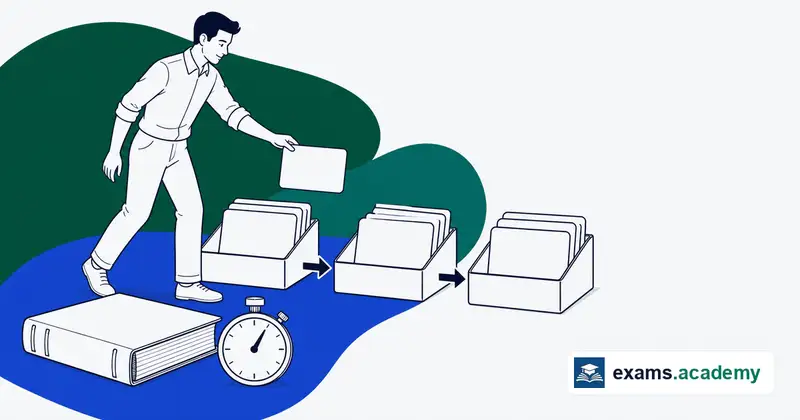
Step 3: Use a Learn–Retrieve–Simulate Cycle
For each domain, move through three distinct modes.
Learn
Read the relevant explanation and create a short structure: definition, mechanism, evidence, control and common trap. For legal and investigative topics, include authority and sequence.
Retrieve
Close the material and answer from memory. Flashcards work when they force a complete response; flipping immediately after recognising a keyword creates an illusion of fluency.
Simulate
Answer unfamiliar questions under time limits. A simulation should reproduce the section’s length and blueprint mix, not simply serve another batch of the questions you memorised during learning.
Do not blend these modes. Immediate explanations are useful during learning, while hidden answers are essential during a readiness test.
Free Certified Fraud Examiner (CFE) Exam Preparation Practice Questions & Exam Preview
Try 15 Certified Fraud Examiner (CFE) Exam Preparation practice questions from Asset Misappropriation: Fraudulent Disbursements
Practice Certified Fraud Examiner (CFE) Exam Preparation exam questions with answers and explanations. The full course includes 5 mock exams and chapter study tools.
Exam Preview
Which statement best describes Billing scheme?
Flashcards
What does Accounting equation mean in CFE exam practice?
Focus Learn
- Accounting statements, timing and analytical techniques
- Cash-receipt, disbursement and inventory misappropriation
- Corruption, information theft, identity and institution fraud
- Money laundering, securities and payment fraud
- Insurance, health care, consumer, bankruptcy and tax fraud
- Cyberfraud, public-sector and procurement schemes
This section asks you to recognize how value is misstated, stolen, diverted or disguised and then choose the control or investigative response that fits the mechanism. Begin with the accounting trail. Assets equal liabilities plus equity; the income statement explains performance over a period; and the cash-flow statement separates operating, investing and financing movements. Accrual accounting records revenue and expense when earned or incurred, while cash accounting follows receipt and payment. That timing distinction matters because many financial-statement schemes manipulate when revenue, expenses, assets or liabilities appear. Fictitious or premature revenue overstates performance, concealed liabilities understate expense, inflated assets distort the balance sheet and incomplete disc…
Unlock all Focus Learn
Open every chapter’s key areas, pitfalls, exam traps and key numbers.
How to Study Each CFE Section
Fraud Schemes and Financial Crimes
Use a scheme matrix instead of isolated definitions. For every fraud type, record:
- how the scheme works;
- which records or relationships it distorts;
- the strongest warning signs;
- the evidence needed to investigate it; and
- the preventive or detective control that addresses the mechanism.
Pay proportionate attention to fraudulent disbursements, procurement fraud, money laundering, accounting concepts, payment fraud and cyberfraud, while still covering the complete blueprint.
Fraud Investigations and Legal Issues
Build process maps. Many distractors describe actions that are generally sensible but legally unavailable, poorly evidenced or performed at the wrong stage.
For each scenario, ask:
- What is the objective at this stage?
- Which authority or permission is required?
- What could compromise evidence or testimony?
- Is the remedy criminal, civil or internal?
- What must be documented?
Interview questions deserve particular care. Separate information-gathering interviews from admission-seeking interviews, and preserve the correct progression within each.
Fraud Prevention and Deterrence
Organise this section around ownership and oversight. Distinguish the board, management, auditors, fraud examiners and employees. Then connect those roles to fraud risk assessment, prevention, reporting, monitoring, response and remediation.
Ethics questions often turn on duties that remain important under pressure: legality, integrity, objectivity, competence, confidentiality and evidence-based conclusions.
How Many Practice Questions Should You Do?
Question volume is useful only when it produces new evidence. Three hundred questions repeated until the wording feels familiar can be less valuable than 100 unseen questions reviewed properly.
Track three numbers:
- first-attempt accuracy on unseen questions;
- corrected accuracy after targeted study; and
- retention accuracy when the same concept returns days later with new wording.
The first number estimates readiness. The second confirms that your repair method works. The third tells you whether the learning lasted.
Set a Readiness Buffer Above 75%
The official requirement is 75% in every section. Your preparation target should include a buffer because practice conditions are usually more comfortable than the live appointment.
A practical personal target is repeated performance around 82–85% on unseen, timed and blueprint-weighted mocks. This is not an ACFE rule and it does not guarantee a pass. It is simply a more defensible readiness signal than scraping 75% once on familiar questions.
Look beneath the total. An 85% result can hide a weak high-weight domain that happened to receive few questions in a poorly balanced mock.
Timing Strategy for the Two Long Sections
The 120-question sections allow 75 seconds per question on average. Use checkpoints rather than watching the clock continuously:
| Progress | Maximum elapsed time | Desired position |
|---|---|---|
| 40 questions | 50 minutes | On pace, with difficult items flagged |
| 80 questions | 100 minutes | No long unresolved cluster |
| 120 questions | 140 minutes | About 10 minutes available for review |
Do not spend four minutes rescuing one difficult item while creating five rushed answers later. Make the best supported selection, flag it and move.
For the 70-question section, aim to finish the first pass in roughly 80 minutes, preserving about 10 minutes for flagged items and completeness checks.
Avoid These CFE Preparation Traps
- Studying from the retired four-section structure: use the current three-section blueprint as the organising authority.
- Memorising answer letters: explain the rule before viewing the options.
- Reading every page with equal intensity: use weights and diagnostic evidence.
- Ignoring True/False practice: the current FAQ states that the exam includes multiple-choice and True/False questions.
- Using untimed mini-quizzes as readiness proof: complete full section-shaped simulations.
- Activating eligibility too early: the current eligibility window is 60 days.
- Assuming one strong section can carry another: 75% is required independently in each section.
When Should You Activate Eligibility?
Activate only when:
- your application is approved;
- you have reviewed all three current sections;
- your work and travel calendar supports three appointments;
- suitable Prometric dates are available;
- your testing equipment and room can meet remote-proctoring requirements if applicable; and
- you have a realistic plan to finish within 60 days.
ACFE recommends scheduling in advance, especially for popular weekend appointments. Confirm all current rules directly with ACFE before activation.
Final 48-Hour Checklist
In the final two days:
- review your error log rather than reopening the entire manual;
- retrieve high-weight distinctions from memory;
- complete a short confidence set, not another exhausting full paper;
- verify identification, appointment time and testing requirements;
- remove technical uncertainty with the required system check; and
- protect sleep and concentration.
The objective is not to encounter every possible question before the exam. It is to build a reliable method for retrieving the governing rule, interpreting the facts, rejecting distractors and maintaining that process under the official time limit.
Frequently Asked Questions
1 How long should I study for the CFE exam?
There is no universal duration. A structured eight-week plan is practical for many working candidates, but your baseline knowledge and available weekly hours should determine the schedule. Use an unseen diagnostic rather than another candidate's timeline.
2 Which CFE exam section should I take first?
There is no officially required order. Use a diagnostic to choose. Starting with Fraud Schemes and Financial Crimes can build broad vocabulary, while beginning with your strongest section can create early momentum.
3 Are practice questions enough to pass the CFE exam?
Practice questions are essential, but repeated-answer recognition is not reliable readiness. Review the underlying rule, explain why distractors fail and confirm performance on unseen, blueprint-weighted mocks.
4 What practice score should I reach before scheduling?
The official pass requirement is 75% in each section. A sensible personal readiness target is a stable margin above 75% on unseen timed mocks, often around 82–85%, but that higher figure is a preparation buffer rather than an ACFE rule.
5 Should I activate CFE exam eligibility before I start studying?
Usually not. ACFE's current eligibility window lasts 60 days after activation, and ACFE advises candidates to be prepared to complete all sections before activating it. Build the foundation and confirm appointment availability first.
6 Is the CFE exam difficult?
Difficulty depends on experience and section. The breadth of fraud schemes, legal sequencing, evidence handling and governance distinctions creates different weaknesses for different candidates. An unseen diagnostic is more useful than a general difficulty rating.
Keep learning
Related Insights

Ready to Prepare for ACFE Certified Fraud Examiner (CFE)?
Use source-grounded study tools and realistic practice to build accurate recall and exam-day confidence.
Explore Course Preparation