
Table of Contents
CME-1A: Introduction to Securities & Investment
Explore syllabus-aligned study tools, realistic practice and course-grounded AI support.

The Saudi Capital Market Examination-1 (CME-1) route comprises two papers: CME-1A, International Introduction to Securities & Investment, and CME-1B, Saudi Capital Market Rules and Regulations. The Financial Academy’s CME-1A page and CME-1B page require both parts for the CME-1 certificate. Confirm the qualification requirements of your intended registrable role.
For the complete qualification structure, current fees, pass scores and the difference between the two papers, start with the Saudi CME-1 exam and certificate guide. This page focuses specifically on question-bank and mock-exam practice.
Choose a question bank for the paper you are preparing to sit. Technical investment questions and Saudi regulatory questions serve related but different learning objectives; a score on one does not diagnose readiness for the other.
This article explains how a CME-1 test bank and mock exam simulator can support recall, application and timed practice alongside the official material.
The Flaw in Passive Reading
When preparing for the CME-1, the default strategy for many candidates is to read the official Financial Academy workbook from cover to cover. They highlight text, take notes, and memorize definitions.
Reading progress alone does not show what you can recall or apply. After a section, close the notes and explain the concept or solve a new question before checking the source.
For CME-1A, include financial markets, products and the other technical syllabus areas. For CME-1B, practise the Saudi regulatory objectives using the applicable current terminology and rules. Do not substitute the regulatory syllabus for the technical one.
Why You Need a Dedicated CME-1 Test Bank
A suitable test bank can help you check recall and application. Judge it by coverage, explanations and the paper it actually supports:
1. Scenario-Based Practice
Use questions that require identifying the relevant facts and explaining the answer. Review why the other options are unsuitable rather than assuming every question contains a trick or requires a Saudi regulatory response.
2. Time Management Training
The Financial Academy currently lists 60 minutes and a passing score of 35 for each paper; the current specifications map each to 50 scored questions. For that base format, 60 minutes divided by 50 is 72 seconds per question before a review buffer. Use the actual sitting’s instructions and timer, including any applicable trial-question allowance.
3. Identifying Weaknesses
Use answer explanations and an error log to identify gaps by the relevant paper’s syllabus area. Repeated securities-business regulation errors concern CME-1B; they do not describe the whole CME-1A technical syllabus. Investigate a low score with both untimed explanations and timed work before deciding that pace is the cause.
The native sample below is specifically CME-1A: 15 questions, 10 flashcards and a summary. Its full course has five 50-question, 60-minute mocks, with 200 distinct questions in mocks 1–4 and a fifth mixed-review paper. Use the CME-1B course for the separate regulatory paper.
Free CME-1A: Introduction to Securities & Investment Practice Questions & Exam Preview
Try 15 CME-1A: Introduction to Securities & Investment practice questions from Equities and Stocks
Practice CME-1A: Introduction to Securities & Investment exam questions with answers and explanations. The full course includes 5 mock exams and chapter study tools.
Exam Preview
Which statement about public and listed companies is correct?
Flashcards
What is the primary function of the financial services sector?
Focus Learn
- Distinction between wholesale and retail sectors
- Functions of Equity, Bond, FX, and Derivatives markets
- Types of Commercial Lending (Lines of credit, Unsecured loans, Term loans)
- Characteristics of Private and Digital/Crypto markets
- Role of Investment Banks in M&A, finance raising, and proprietary trading
- Key functions of Custodian banks (safekeeping, settlement, asset servicing)
- Definition of a financial conglomerate by the Bank for International Settlements (BIS)
- Concept of mutual societies and the demutualization process
- Distinction between P2P lending and Crowdfunding forms
- The role of Insurance Companies and Pension Funds as major market investors
Financial Markets Overview
The financial services sector links organizations seeking capital with those with capital available to invest. The wholesale/professional sector includes Equity markets (trading shares on regulated exchanges with indices like S&P 500, FTSE 100), Bond markets (debt instruments for raising capital, influenced by interest rates and credit risk), Foreign Exchange (decentralized OTC trading of currencies for trade, speculation, and hedging), Derivatives (trading options, swaps, futures based on underlying assets like interest rates, mostly OTC but moving to exchanges), Insurance (management of personal/corporate risk, dominated by entities like Lloyd's and large reinsurers like Munich Re), Commercial Lending (business loans, term loans, unsecured loans, lines of…
Unlock all Focus Learn
Open every chapter’s key areas, pitfalls, exam traps and key numbers.
The “CME-4B” and Beyond
Your intended role may require a different paper, such as CME-4B. Confirm that requirement first, then select practice covering that paper. An approach to reviewing mistakes can transfer between exams; the underlying rules and question coverage must be checked separately.
Build practice around the official material, source-based error review and unseen timed attempts. No product, practice format or number of retakes guarantees a pass.
Frequently Asked Questions
1 Is the Financial Academy workbook enough to pass CME-1?
Use the current official material as the primary teaching source and test whether you can recall and apply it without prompts. A commercial question bank is a practice aid, not a mandatory or guaranteed route to passing. CME-1A and CME-1B require separate coverage.
2 Where can I find a realistic CME-1 test bank?
The native CME-1A preview below provides 15 questions with explanations, 10 flashcards and a summary. The full CME-1A course has five 50-question mocks; the first four contain 200 distinct questions and the fifth uses mixed review. Choose separate CME-1B materials for the Saudi regulatory paper.
3 Are there CME-4B practice questions available?
CME-4B is a separate Saudi regulatory paper. Select practice mapped to that paper and the requirements of your intended role; the CME-1A sample on this page does not demonstrate CME-4B coverage.
4 How many mock exams should I take before the real CME-1 test?
Use unseen timed work to assess coverage and pace, then revisit errors in the official sources. Keep repeated-paper and mixed-review scores separate from first attempts. No fixed number of mocks or retakes ensures a pass.
5 What is the format of the CME-1 exam?
CME-1 comprises CME-1A, the international technical paper, and CME-1B, the Saudi regulatory paper. The Financial Academy currently publishes 60 minutes and a passing score of 35 for each; the current learning specifications map each to 50 scored questions. Confirm the instructions and policies for your booked sitting.
Keep learning
Related Insights

US CMA vs Saudi CMA CME-1: Clearing the Confusion
Discover the critical differences between the US Certified Management Accountant (CMA) and the Saudi Capital Market Authority (CMA) CME-1 exams to choose the right career path.

أيهما تبدأ به أولاً: اختبار CME-1A أم CME-1B؟ وما هي المدة المطلوبة للمذاكرة؟
دليل شامل للمقارنة بين اختباري CME-1A و CME-1B من حيث الصعوبة، مدة المذاكرة المطلوبة، وأيهما الأفضل للبدء به في مسيرتك المهنية في القطاع المالي.
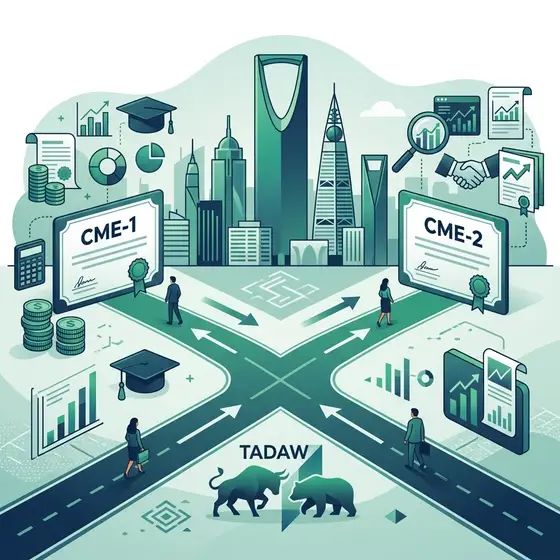
CME-1 vs CME-2: Which CMA Saudi Certification Do You Need?
Confused about the difference between the CME-1 and CME-2 exams? Discover the requirements, career benefits, and which Saudi CMA certification you should take first.
Ready to Prepare for Your Exam?
Prepare with syllabus-aligned study tools, realistic practice and course-grounded AI support.
Explore Courses