
Table of Contents
CME-1B: Saudi Capital Market Rules and Regulations – General
Explore syllabus-aligned study tools, realistic practice and course-grounded AI support.
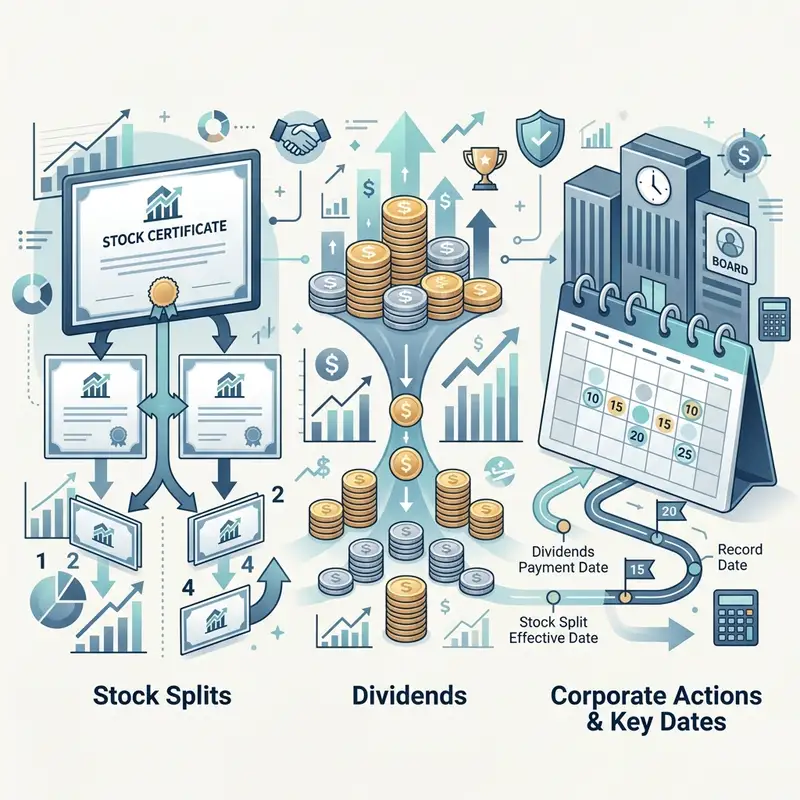
Corporate actions and reconciliations are useful securities-operations concepts, but CME-1B is Saudi Capital Market Rules and Regulations (General), not the CISI Global Securities Operations exam. The current Financial Academy outline assigns CME-1B to eight regulatory chapters and does not identify corporate actions or reconciliations as a heavily tested chapter.
Operations teams must process thousands of these events flawlessly, as mistakes can cost firms millions of dollars in missed entitlements or incorrect tax payments.
Understanding Corporate Actions
A corporate action is an event initiated by a public company that brings a material change to its securities. Operations teams commonly classify these events into three main groups:
1. Mandatory Corporate Actions
These happen automatically. The shareholder has no choice and is not required to do anything. The operations team processes the event based on the holdings on the record date.
- Examples: Cash Dividends, Stock Splits, Bonus Issues (Scrip Issues).
2. Voluntary Corporate Actions
These require the shareholder to make an active decision. If the shareholder does not reply before the deadline, a default action (usually doing nothing) is applied.
- Examples: Tender Offers (Buybacks), Rights Issues (where the shareholder has the choice to buy more shares, sell the rights, or let them lapse).
3. Mandatory with Options
A hybrid category where the event will happen to the shareholder, but they get to choose how they receive the benefit. If they don’t choose, a default option is applied.
- Examples: Scrip Dividends (the choice to receive a dividend in cash OR in additional shares).
Free CME-1B: Saudi Capital Market Rules and Regulations – General Practice Questions & Exam Preview
Try 15 CME-1B: Saudi Capital Market Rules and Regulations – General practice questions from Securities Business and Capital Market Institutions
Practice CME-1B: Saudi Capital Market Rules and Regulations – General exam questions with answers and explanations. The full course includes 5 mock exams and complete syllabus coverage.
Exam Preview
Which of the following lists correctly identifies the five types of securities business activities?
Flashcards
What is the Capital Market Authority (CMA)?
Focus Learn
- Capital Market Law establishment: Royal Decree M/30 dated 2/6/1424H (31 July 2003).
- CMA independence and direct reporting line to the Prime Minister.
- Definitions of securities (4 types) vs. non-securities (7 excluded instruments).
- CMA trading suspension powers: 1 day independent, >1 day requires Minister of Finance approval.
- Committee for Resolution of Securities Disputes: composition, appointment, and jurisdiction.
- Dispute timeline: 90-day filing wait, 14-day consideration start, 30-day appeal window.
- Securities Depository Center: sole registration entity, preliminary registration in doubtful cases.
- Evidence admissibility in all forms including electronic, recordings, fax, and email.
The Saudi Arabian Capital Markets have informally operated since 1950, but the Capital Market Law (the Law) was formally introduced pursuant to Royal Decree M/30 dated 2/6/1424H (31 July 2003) to create a transparent, fair, and regulated market. The Law established the Capital Market Authority (CMA) as a fully independent government organisation that reports directly to the Prime Minister — not to SAMA or any ministry. The CMA's four core objectives are: creating an appropriate investment environment, boosting confidence, reinforcing transparency and disclosure standards, and protecting investors and dealers from illegal acts. Securities under the Law include: (a) convertible and tradeable company shares, (b) tradeable debt instruments issued by companies, government, or public institution…
Unlock all Focus Learn
Open every chapter’s key areas, pitfalls, exam traps and key numbers.
The Importance of Reconciliations
Because corporate actions (and trades) are happening constantly, the operations team must perform daily Reconciliations.
Reconciliation is simply the act of comparing the firm’s internal system balances against the statements provided by the external Custodian. If the firm thinks it holds 10,000 shares of Apple for clients, but the Custodian says they only hold 9,500, that is a ‘break’ or exception that must be investigated immediately.
Conclusion
These mechanics are useful for back-office operations work. For CME-1B, prioritise the eight published chapters, especially regulatory requirements, the Saudi capital-market framework, prohibited conduct, AML/CFT and supervisory systems, and treat this article as supporting operations context rather than an exam weighting guide.
Frequently Asked Questions
1 What is a mandatory corporate action?
A mandatory corporate action is an event initiated by a company that affects all shareholders and requires no active decision from the investor (e.g., a stock split).
2 What is a voluntary corporate action?
A voluntary corporate action requires the shareholder to make a choice or take action (e.g., a rights issue or a tender offer).
3 Why is reconciliation important in securities operations?
Reconciliation compares the firm's internal records with external custodian records so discrepancies can be investigated. It is a useful securities-operations control, but the current CME-1B outline does not list corporate actions or reconciliation as a separate exam chapter.
Keep learning
Related Insights

GSCMR CME-1B: Custody and Safekeeping of Assets Guide
A technical guide to Nominee accounts, Omnibus accounts, and segregation of client assets for the CISI GSCMR CME-1B exam.

How to Prepare for Saudi CME-1B: Regulatory Study Strategy
A focused preparation strategy for the current Saudi CME-1B regulatory exam, covering CMA rules, active recall, scenario practice, and timed mock exams.

Finding a Bilingual CME-1 Tutor in Saudi Arabia
Why finding a bilingual CME-1 tutor for the Saudi CMA regulations is difficult, and how online study platforms offer a better, cost-effective alternative.
Ready to Prepare for Your Exam?
Prepare with syllabus-aligned study tools, realistic practice and course-grounded AI support.
Explore Courses