
Table of Contents
CISI Operational Risk
Explore syllabus-aligned study tools, realistic practice and course-grounded AI support.
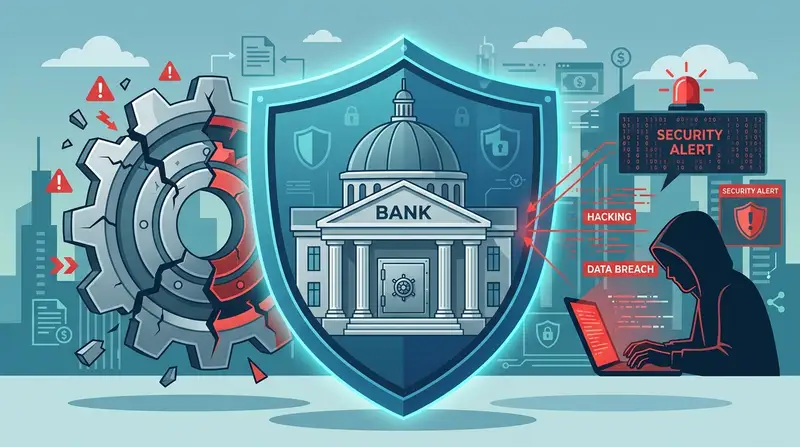
Operational Risk is defined by the Basel Committee as “the risk of loss resulting from inadequate or failed internal processes, people, and systems or from external events.”
For candidates taking the CISI Operational Risk exam, memorizing definitions is not enough; you must classify the loss event, identify the failed control and select a proportionate response. The five examples below are not the complete loss-event taxonomy. Employment Practices and Workplace Safety, and Business Disruption and System Failures are two other categories that must still be revised.
A useful rule for ambiguous cases is to classify the event that produced the loss, not only its root cause. A ransomware intrusion may begin as external fraud, for example, while the resulting outage may also create a business-disruption incident.
1. Internal Fraud (The Rogue Trader)
Internal fraud occurs when an employee intentionally bypasses controls for personal gain or to hide losses.
- Example: Nick Leeson at Barings Bank or Kweku Adoboli at UBS.
- Mitigation: Strict segregation of duties, mandatory block leave (making it hard to hide ongoing fraud), and rigorous reconciliation processes.
- Early warning indicator: Unreconciled positions, repeated limit overrides, cancelled confirmations or unusual profit patterns concentrated under one employee.
2. External Fraud (Cyber Attacks)
This involves third parties attempting to steal data or funds.
- Example: Ransomware attacks shutting down bank servers or phishing campaigns stealing client credentials.
- Mitigation: Multi-factor authentication (MFA), robust firewall configurations, and continuous employee cybersecurity training.
- Early warning indicator: Spikes in failed logins, impossible-travel alerts, privilege escalation or a sudden rise in blocked outbound traffic.
3. Execution, Delivery, and Process Management
These are ‘fat finger’ errors or systemic failures in processing transactions.
- Example: A trader accidentally typing an extra zero on a sell order, causing a flash crash.
- Mitigation: Automated trade limit checks, straight-through processing (STP) to reduce manual entry, and robust four-eye checks for large transactions.
- Early warning indicator: Manual overrides, amended settlements, unmatched trades or an increasing exception queue near cut-off times.
Free CISI Operational Risk Practice Questions & Exam Preview
Try 15 CISI Operational Risk practice questions from The Nature of Operational Risk
Practice CISI Operational Risk exam questions with answers and explanations. The full course includes 5 mock exams and chapter study tools.
Exam Preview
An international bank is drafting its new operational risk policy to define risk appetite and establish boundaries between operational, market, and credit risk. The Chief Risk Officer proposes that the policy only be signed off by the heads of each division to ensure local buy-in. According to best practices in operational risk management, what is the primary flaw in this approach?
Flashcards
How does the Basel Committee on Banking Supervision (BCBS) formally define Operational Risk?
Focus Learn
- Distinguish likelihood from consequence in a risk definition.
- Classify credit, market, liquidity and operational risk in practical scenarios.
- Explain what Invesco, PPI, LIBOR, HSBC, Bank of Bangladesh and other named events show about controls.
- State ERM's four practical aims and its firm-wide scope.
- Explain why common definitions, data and culture matter to ERM.
Risk is the possibility of an adverse consequence, not the certainty that an event will occur. A firm therefore considers both the likelihood of an event and what it would lose if the event happened. In financial services, the four broad categories are credit, market, liquidity and operational risk. Credit concerns a borrower or counterparty failing to meet an obligation. Market risk concerns adverse changes in financial-instrument values. Liquidity has an asset side (a position cannot be sold promptly at a reasonable price) and a funding side (the firm cannot meet payments when due). Operational risk concerns losses from inadequate or failed processes, people, systems or external events. One incident can engage several categories, so identify the actual cause and consequence before choosi…
Unlock all Focus Learn
Open every chapter’s key areas, pitfalls, exam traps and key numbers.
4. Damage to Physical Assets
Losses resulting from physical destruction of property.
- Example: A fire, flood, or earthquake destroying a primary data center.
- Mitigation: Comprehensive Business Continuity Planning (BCP) and off-site data replication/disaster recovery sites.
- Early warning indicator: Overdue recovery tests, failed backups, unresolved generator faults or recovery times that exceed the approved objective.
5. Clients, Products, and Business Practice
Losses arising from an unintentional or negligent failure to meet a professional obligation to specific clients.
- Example: Mis-selling high-risk derivatives to retail pensioners, resulting in massive regulatory fines.
- Mitigation: Strict Know Your Customer (KYC) protocols, suitability checks, and ethical sales training.
- Early warning indicator: Concentrated sales to vulnerable clients, suitability overrides, repeated complaints or high cancellation and remediation rates.
Conclusion
For each practice question, write four short answers: the loss-event category, the failed control, one preventive control and one indicator that would give earlier warning. This exposes the difference between knowing a definition and applying it to an incident.
Frequently Asked Questions
1 Is this topic heavily tested?
Operational-risk identification, controls and incident analysis are central to the subject. Use the syllabus version for your exam date to see the exact allocation rather than assuming a fixed number of questions.
2 How long does it take to master this?
There is no reliable one-to-two-week rule. Start with a closed-book scenario set, then plan study around the categories and controls you misclassify.
3 Are there mock exams available?
Yes, our platform provides comprehensive mock exams covering these exact topics.
Keep learning
Related Insights

CISI Operational Risk Exam Guide: Everything You Need to Know
A comprehensive guide to passing the CISI Operational Risk exam, covering Basel frameworks, risk modeling, and exam preparation strategies.
CISI Operational Risk Mock Exams & Free Sample Questions (2026)
Prepare for the CISI Operational Risk exam with 250 practice questions across five mock exams and free sample questions aligned to Edition 26.

CISI MORFI Level 4 Exam Guide: Syllabus, Weightings and Study Plan
Prepare for CISI MORFI Level 4 with the 40-question exam format, six syllabus weightings, a practical 91-hour study plan and current 2026 preparation guidance.
Ready to Prepare for Your Exam?
Prepare with syllabus-aligned study tools, realistic practice and course-grounded AI support.
Explore Courses