
Table of Contents
ACAMS CAMS
Explore source-grounded summaries, flashcards, reference tools and realistic mock practice.
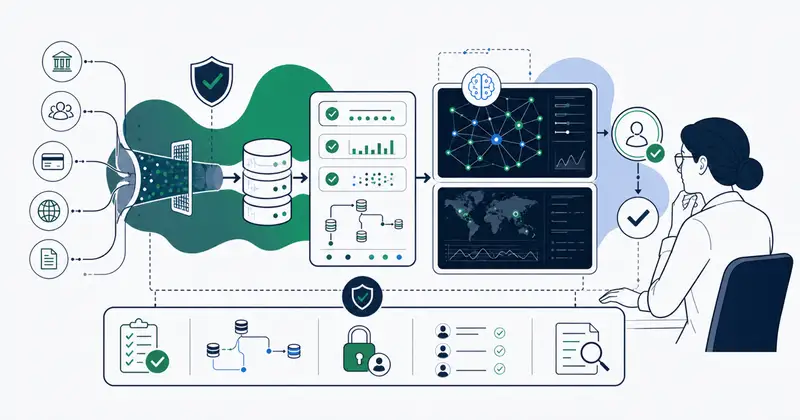
Quick answer: Effective AML technology and AI begins with the risk and control problem, not the vendor feature. Reliable data, validated design, tested integration, traceable outputs, human review and accountable governance determine whether the tool improves detection or creates a hidden gap.
The current CAMS blueprint gives Tools and Technologies 20% of the exam. Candidates should be able to evaluate the complete lifecycle: onboarding, KYC, screening, transaction monitoring, investigations, reporting and customer exit.
Start With the Control Requirement
A sound selection process asks:
- What financial-crime risk must the control address?
- Is the control preventive, detective or investigative?
- Which customer, product, channel and jurisdiction data is required?
- What workflow follows the output?
- Who reviews, approves and challenges the result?
- How will failures, changes and performance be detected?
Buying a tool before answering those questions can automate an unclear or incomplete process.
The Five Data-Quality Questions
| Dimension | Control question |
|---|---|
| Accuracy | Does the value correctly represent the customer, relationship, transaction or event? |
| Completeness | Are all material fields present, including ownership and expected activity where relevant? |
| Timeliness | Does the information reach the control soon enough for the intended action? |
| Lineage | Can the organisation trace the source field, transformation, destination and fallback rule? A booking date mapped as value date can leave every field populated while the control evaluates the wrong event. |
| Taxonomy | Do systems and teams interpret fields and risk categories consistently? |
Missing beneficial-owner data can invalidate a screening result. Delayed sanctions-list deployment can make a preventive control late. An inconsistent country code can break segmentation or routing even when the source record is correct.
Digital Identity Tools Answer Narrow Questions
Document verification, biometric comparison, liveness testing and geolocation can make remote onboarding more reliable. Each has a limited purpose.
- Document verification assesses authenticity and consistency.
- Biometric comparison connects a person with identity evidence.
- Liveness checks help identify presentation attacks.
- Geolocation can expose inconsistency between access location and declared information.
None independently establishes beneficial ownership, relationship purpose, source of funds or expected activity. Strong CDD combines the tool output with the wider customer picture.
Free ACAMS Certified Anti-Money Laundering Specialist (CAMS) Practice Questions & Exam Preview
Try 15 ACAMS Certified Anti-Money Laundering Specialist (CAMS) practice questions from Building an Anti-Financial Crime Compliance Program
Practice ACAMS Certified Anti-Money Laundering Specialist (CAMS) exam questions with answers and explanations. The full course includes 5 mock exams and complete syllabus coverage.
Exam Preview
Which CAMS knowledge point is defined or described by the following statement? Risk is dynamic and needs to be continuously managed, and the environment in which each organization operates is subject to continual change.
Flashcards
What is money laundering?
Focus Learn
- Definitions and relationships among AML, CFT, sanctions, fraud, bribery/corruption and tax evasion
- Placement, layering and integration without forcing every case into a rigid sequence
- Economic, social, operational, legal, reputational and concentration consequences
- Banking risks: transfers, correspondent banking, payable-through accounts, concentration accounts and private banking
- PEPs, high-risk customers, source of wealth/funds and structuring
- MSBs, PSPs, ecommerce, prepaid access, securities, insurance and virtual assets
- Casinos, real estate, high-value goods, gatekeepers, accountants and TCSPs
- Trade-based laundering, BMPE, corporate vehicles, trusts and beneficial ownership
- Terrorist-financing channels, informal value transfer systems and nonprofit organizations
Financial crime risk begins with the purpose and movement of value. Money laundering takes criminal proceeds and disguises their illegal source so the value can be used in apparently legitimate or further illegal activity. The familiar placement, layering and integration model remains useful: placement introduces criminal value into the financial system, layering creates distance and complexity, and integration returns the value in a form that appears legitimate. Real cases do not always follow a neat sequence, so the examiner may give facts that combine stages. Focus on what the transaction is doing: entering the system, obscuring the trail, or allowing apparently legitimate enjoyment of the proceeds.
The current CAMS domain is wider than money laundering alone. Counter-terrorist financi…
Unlock all Focus Learn
Open every chapter’s key areas, pitfalls, exam traps and key numbers.
Screening and Monitoring Technology
Exact-name matching can identify strong literal matches but miss aliases, transliteration, spelling variation or incomplete data. Fuzzy matching can find approximate similarity, but broader logic may increase false positives. List source, scope, fields, version, update timing and deployment therefore need governance.
Transaction monitoring depends on meaningful customer segmentation, scenario coverage and evidence-based threshold tuning. The goal is not the smallest alert queue. It is effective detection with proportionate use of people and time.
Periodic KYC refresh follows a planned schedule. Perpetual KYC uses event signals to identify material change between reviews and route it for validation. An event signal is a prompt to reassess, not an automatic customer decision.
Governed Use of AI and Machine Learning
AI and machine learning can help prioritise alerts, identify networks, detect patterns and organise evidence. Before reliance increases, the organisation should address:
- data and model assumptions;
- validation and parallel testing;
- acceptance criteria;
- explainability and traceability;
- human review and escalation;
- fallback when the tool fails;
- change control; and
- ongoing performance and drift monitoring.
Automation bias is a central risk. A confident score or visual network can make a weak conclusion feel objective. A graph link or blockchain path remains an investigative indicator until identity, attribution, context and legal relevance are assessed.
Integration Can Break a Good Tool
Implementation testing should confirm field mapping, transformation, timing, failure handling and downstream workflow. A model validated on clean source data may fail when a production interface truncates names, drops identifiers or updates too slowly.
Access, retention, security, auditability and permitted purpose also matter. Privacy by design aligns data minimisation and protection with the AFC purpose rather than treating privacy as a reason to ignore risk or AFC as a reason to collect everything.
CAMS Exam Traps
- Vendor feature first: begin with risk, control, data and workflow requirements.
- Identity tool equals CDD: understand the narrow question each tool answers.
- Fewer alerts equals better detection: validate coverage and missed risk.
- AI score equals final decision: preserve accountability and human escalation.
- Network link equals proof: treat it as an investigative lead.
- Successful model test equals successful integration: verify the production data path and workflow.
Apply these controls to the case lifecycle in transaction monitoring alert investigation and to role ownership in the three lines of defence.
The exam-safe principle is direct: technology changes how the work is performed; it does not remove the need for evidence, governance or accountable judgment.
Frequently Asked Questions
1 What data-quality dimensions matter to AML technology?
Important dimensions include accuracy, completeness, timeliness, lineage and consistent taxonomy. A sophisticated tool cannot produce a reliable control outcome when material identity, ownership, transaction or event data is wrong or missing.
2 Can AI make AML decisions without human review?
AI can support prioritisation, matching, pattern recognition and investigation, but accountable use requires validation, monitoring, traceability, escalation and appropriate human review. The organisation remains responsible for the outcome.
3 What is automation bias?
Automation bias is the tendency to accept a tool's output without sufficient challenge, especially when its data, assumptions or reasoning are incomplete. Reviewers must understand what the output establishes and what it does not.
4 Is a biometric or liveness check the same as CDD?
No. Those tools can support specific identity questions, but they do not establish beneficial ownership, business purpose, source of funds, expected activity or the full customer risk.
5 Does fewer monitoring alerts prove better technology?
No. Reduced volume may reflect better targeting or a detection gap. Effectiveness requires scenario coverage, threshold testing, investigation outcomes and evidence that material risk is still detected.
Keep learning
Related Insights

FATF, FIUs, Regulators and Law Enforcement: Who Does What?
Separate the roles of FATF, FIUs, regulators, law enforcement and courts so CAMS exam answers assign standards, intelligence and decisions correctly.

Three Lines of Defence in AML: Roles and Exam Traps
Understand the three lines of defence in AML, who owns controls, how compliance challenges and why independent assurance must not test its own work.
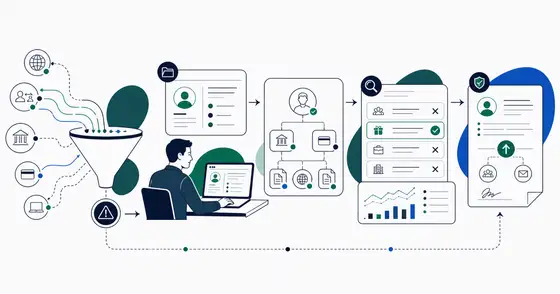
Transaction Monitoring Alert Investigation: CAMS Workflow
Follow a transaction monitoring alert from detection through investigation, evidence, escalation and closure while avoiding alert-volume and automation traps.
Ready to Prepare for ACAMS CAMS?
Use source-grounded study tools and realistic practice to build accurate recall and exam-day confidence.
Explore Course Preparation