
Table of Contents
CISI Regulations and Market Practice Kenya
Explore syllabus-aligned study tools, realistic practice and course-grounded AI support.
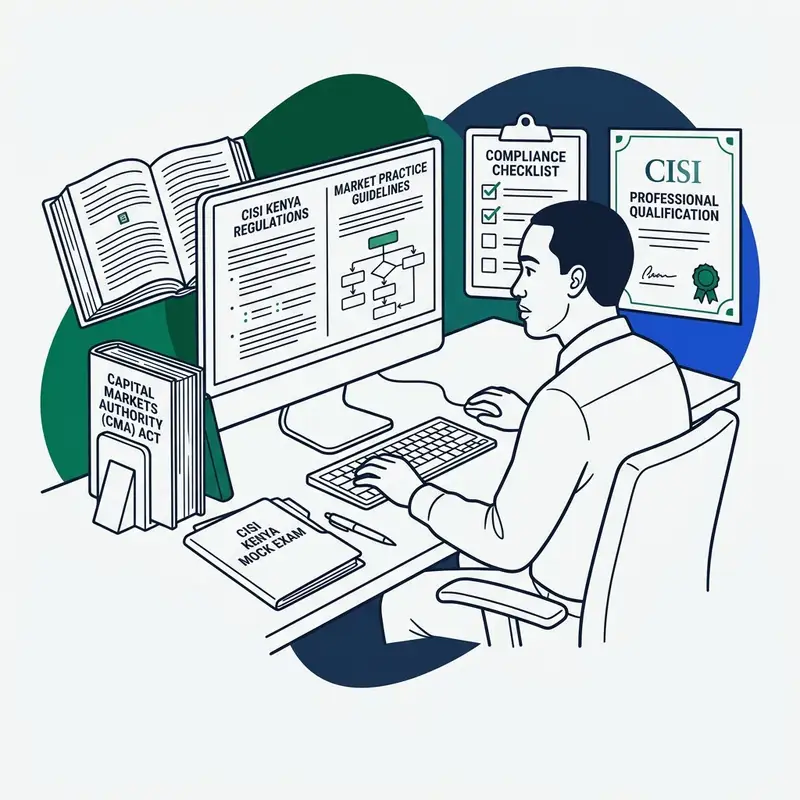
Why Mock Exams Matter for CISI Kenya
The CISI Regulations and Market Practice Kenya qualification is a crucial stepping stone for finance professionals in East Africa. The exam tests your understanding of the specific regulatory environment governing Kenyan capital markets, requiring you to navigate complex local rules alongside international best practices.
Relying solely on the official textbook is rarely enough. Mock exams are essential because they force you to apply your knowledge to realistic, scenario-based questions. They highlight your blind spots, improve your pacing, and ultimately build the confidence required to succeed on exam day.
What Makes Our Sample Paper Different
We don’t just offer generic questions; we provide a highly specialized preparation tool. Here is why our mock exams are the best choice for your CISI Kenya studies:
- Rule-Specific Explanations: The rationale identifies the Kenyan rule or market-practice distinction being tested and gives candidates a precise point to verify.
- Transparent Student Reviews: We proudly display real, verified ratings and reviews openly. Our transparent approach means you can trust the quality of our materials based on the genuine success of past candidates.
- Five 50-Question Papers: The current inventory is 250 questions, so candidates can track performance paper by paper without relying on an inflated count.
- Source-Controlled Revisions: Confirmed changes to the syllabus or cited Kenyan rules are reviewed before affected questions are updated.
- Free Sample Paper: We offer a full, easily accessible free sample paper so you can verify the quality of our platform for yourself without any commitment.
Try Our Free Sample Paper
The best way to evaluate a study resource is to use it. We encourage you to test your current knowledge level right now.
Take our Free Sample Paper for CISI Regulations and Market Practice Kenya. This sample gives you immediate access to premium questions, complete with the detailed explanations that define our platform.
Unmatched Question Bank Coverage
The CISI Kenya syllabus is broad, covering everything from the Capital Markets Authority (CMA) guidelines to the Nairobi Securities Exchange (NSE) trading rules, ethics, and corporate governance.
Our rich question bank is carefully categorized to mirror the official syllabus structure. Whether you need extra practice on collective investment schemes or the nuances of market abuse regulations in Kenya, our targeted mock exams provide the focused drill-down capability you need to turn weaknesses into strengths.
Student Reviews & Pass Rates
Our community-polished approach yields results. Candidates who utilize our mock exams consistently report feeling more prepared and less anxious on test day.
By browsing our transparent student reviews, you will see a common theme: our questions perfectly simulate the real exam experience. This level of realistic preparation translates directly into higher first-time pass rates for our users.
Free CISI Regulations and Market Practice (Kenya) Practice Questions & Exam Preview
Try 15 CISI Regulations and Market Practice (Kenya) practice questions from Market Disclosures
Practice CISI Regulations and Market Practice (Kenya) exam questions with answers and explanations. The full course includes 5 mock exams and chapter study tools.
Exam Preview
Within how many days of the books' closed date must interim dividends be paid to shareholders?
Flashcards
What are the two primary acts of Parliament governing the Kenyan capital markets?
Focus Learn
- Statutory Framework: Broad structures established by the Capital Markets Act CAP 485A and Central Depositories Act CAP 485C.
- Cabinet Secretary vs. CMA Powers: The Cabinet Secretary issues regulations, whereas the CMA issues guidelines, notices, and directives.
- High Court Appeal Process: Aggrieved parties can appeal a CMA decision on a point of law within 30 days of the decision date.
- General Fines & Imprisonment Penalties: Individual fines up to Kshs 5 million / 5 years prison, and company fines up to Kshs 10 million + 2x gain/loss.
- Specialized Regulations: Derivatives index fees (0.14% equity, 0.17% single stock) and Online Forex Brokers (3% gross revenue renewal fee).
- International Organizations: The role of IOSCO and the three main objectives of securities regulation.
- Regional Integration: The East African Community (EAC) Directives, the role of EASRA, and the drive for a common market infrastructure.
This chapter establishes the core statutory and regulatory architecture of the Kenyan capital markets. The primary legislation includes the Capital Markets Act CAP 485A and the Central Depositories Act CAP 485C, which establish the Capital Markets Authority (CMA) as the independent regulatory body. The Cabinet Secretary for the National Treasury holds the power to issue subsidiary regulations, while the CMA publishes guidelines, notices, and directives to ensure market fairness and order.
The regulatory framework is designed to promote the development of Kenya's capital markets, protect investors, and ensure fair, efficient, and transparent markets. The CMA is a statutory agency, and it remains accountable to Parliament. Within six months after the close of each financial year, the CMA m…
Unlock all Focus Learn
Open every chapter’s key areas, pitfalls, exam traps and key numbers.
How to Use Mock Exams Effectively
To get the most out of the five-paper, 250-question bank, follow this strategy:
- Take a Baseline Test: Use the free sample paper early in your studies to identify which chapters require the most focus.
- Study the Explanations: Even if you guess correctly, read our detailed rationales. Understanding the ‘why’ is critical for long-term retention.
- Simulate the Real Thing: As the exam approaches, take full-length mock exams under timed, closed-book conditions.
- Target Your Weaknesses: Review your scores by topic and revisit the official workbook for areas where you consistently score lower.
With dedicated study and the support of our premium, community-reviewed practice materials, you will be well on your way to mastering the CISI Kenya Regulations and Market Practice exam.
Frequently Asked Questions
1 Where can I find a free sample paper for the CISI Kenya exam?
You can find our free sample paper right here on Exams Academy. It is designed to perfectly replicate the style and difficulty of the actual exam.
2 Are your CISI Kenya mock exams updated for the latest syllabus?
The course is checked against the identified Kenya syllabus and official regulatory sources, with changes issued as reviewed versions rather than hourly candidate-driven edits.
3 How many practice questions do you offer for CISI Kenya Regulations?
The current course source contains 250 questions in five 50-question mock exams.
4 Who reviews the questions on Exams Academy?
The questions are maintained through the course's editorial and source-verification process. They are independent practice content and are not represented as official CISI questions.
5 Can I see what other students thought of your mock exams?
Yes, we maintain completely transparent student reviews. You can read genuine feedback and verified ratings from past candidates who have used our platform.
Keep learning
Related Insights

Passing the CISI Kenya Regulations and Market Practice Exam
Master the CMA Kenya regulatory framework, licensing rules, market conduct, and trading systems to pass your CISI Kenya RMP exam on the first attempt.

Best CISI Corporate Finance Regulation Mock Exams & Free Sample Papers (2026)
Discover the best mock exams and free sample papers for the CISI Certificate in Corporate Finance Regulation. Access our extensive question bank and community-polished questions.
Best CISI Kuwait CMA Rules & Regulations Mock Exams & Free Sample Papers (2026)
Pass your CISI Kuwait CMA exam with confidence using our best mock exams and free sample papers. Featuring community-polished questions and hourly syllabus tracking.
Ready to Prepare for Your Exam?
Prepare with syllabus-aligned study tools, realistic practice and course-grounded AI support.
Explore Courses