
Table of Contents
- • Chapter 1: The Regulatory Framework & The CMA
- • Chapter 2: Licensing and Capital Adequacy
- - Minimum Paid-Up Capital Requirements
- • Chapter 3: Governance and Internal Controls
- • Chapter 4: Conduct of Business
- • Chapter 5: Markets and Trading Rules
- • Chapter 6: Investment Funds (CIS and REITs)
- • How to Prepare for Exam Day
CISI Regulations and Market Practice (Kenya)
Explore syllabus-aligned study tools, realistic practice and course-grounded AI support.

Key Takeaways
- Exam Details: 50 MCQs, 60 minutes, 70% passing score (35/50).
- Primary Focus: Chapter 4 (Conduct of Business) represents 30% of the exam (15 questions).
- Core Strategy: Memorize specific licensing capital requirements, reporting timelines, and penalty amounts under the CMA rules.
- Study Tool: Access our CISI Kenya Regulations and Market Practice course to practice with interactive mock exams and active-recall flashcards.
The CISI Regulations and Market Practice (Kenya) certification is the mandatory licensing exam required by the Capital Markets Authority (CMA) for professionals seeking to work as stockbrokers, investment advisers, fund managers, and compliance officers in the Kenyan financial markets.
To help you navigate this technical syllabus, we have compiled an in-depth breakdown of the core chapters, key regulatory thresholds, and exam preparation tips.
Chapter 1: The Regulatory Framework & The CMA
The Kenyan capital markets are governed by the Capital Markets Act (CAP 485A). The Capital Markets Authority (CMA) acts as the principal regulator, holding wide-ranging powers to license intermediaries, supervise the exchange, and protect investor interests.
Candidates must master:
- CMA Powers: The authority to inspect books during business hours, issue directives, suspend licenses, and impose administrative penalties.
- Capital Markets Tribunal (CMT): An independent appeals body. If a firm is aggrieved by a CMA decision, it must appeal to the CMT within 15 days of the decision.
- Regulatory Sandbox: Established in 2020 to test innovative financial products. The testing period is capped at 12 months, with a potential extension of up to 12 months.
Chapter 2: Licensing and Capital Adequacy
To operate in Kenya, market intermediaries must be licensed under specific categories. The exam tests the exact paid-up capital requirements and ongoing financial ratios for each category.
Minimum Paid-Up Capital Requirements
- Investment Bank: Kshs 250 million
- Stockbroker: Kshs 50 million
- REIT Manager: Kshs 10 million
- Venture Capital Company: Kshs 100 million (with a minimum fund size of Kshs 100 million)
Intermediaries must also maintain capital adequacy ratios:
- Liquid Capital: Must be higher than the prescribed minimums.
- Working Capital: Current assets must exceed current liabilities at all times.
- Deficiency Reporting: Any drop below adequacy ratios must be reported to the CMA within 24 hours.
Chapter 3: Governance and Internal Controls
A robust internal control framework is mandatory for all licensed intermediaries to manage operational risk and comply with anti-money laundering (AML) legislation.
- Compliance Officer: Responsible for day-to-day oversight. A shareholder holding more than 25% shareholding in the firm cannot be appointed as the Compliance Officer to ensure independence.
- Record-Keeping: All client transactions, books, and compliance records must be preserved for a minimum of 7 years.
- AML/CFT: Suspicious transactions must be reported to the Financial Reporting Centre (FRC) within 24 hours of detection.
Free CISI Regulations and Market Practice (Kenya) Practice Questions & Exam Preview
Try 15 CISI Regulations and Market Practice (Kenya) practice questions from Market Disclosures
Practice CISI Regulations and Market Practice (Kenya) exam questions with answers and explanations. The full course includes 5 mock exams and chapter study tools.
Exam Preview
Within how many days of the books' closed date must interim dividends be paid to shareholders?
Flashcards
What are the two primary acts of Parliament governing the Kenyan capital markets?
Focus Learn
- Statutory Framework: Broad structures established by the Capital Markets Act CAP 485A and Central Depositories Act CAP 485C.
- Cabinet Secretary vs. CMA Powers: The Cabinet Secretary issues regulations, whereas the CMA issues guidelines, notices, and directives.
- High Court Appeal Process: Aggrieved parties can appeal a CMA decision on a point of law within 30 days of the decision date.
- General Fines & Imprisonment Penalties: Individual fines up to Kshs 5 million / 5 years prison, and company fines up to Kshs 10 million + 2x gain/loss.
- Specialized Regulations: Derivatives index fees (0.14% equity, 0.17% single stock) and Online Forex Brokers (3% gross revenue renewal fee).
- International Organizations: The role of IOSCO and the three main objectives of securities regulation.
- Regional Integration: The East African Community (EAC) Directives, the role of EASRA, and the drive for a common market infrastructure.
This chapter establishes the core statutory and regulatory architecture of the Kenyan capital markets. The primary legislation includes the Capital Markets Act CAP 485A and the Central Depositories Act CAP 485C, which establish the Capital Markets Authority (CMA) as the independent regulatory body. The Cabinet Secretary for the National Treasury holds the power to issue subsidiary regulations, while the CMA publishes guidelines, notices, and directives to ensure market fairness and order.
The regulatory framework is designed to promote the development of Kenya's capital markets, protect investors, and ensure fair, efficient, and transparent markets. The CMA is a statutory agency, and it remains accountable to Parliament. Within six months after the close of each financial year, the CMA m…
Unlock all Focus Learn
Open every chapter’s key areas, pitfalls, exam traps and key numbers.
Chapter 4: Conduct of Business
The current CISI Version 3 specification allocates 18 of 50 questions, or 36%, to Conduct of Business. CISI notes that allocations may vary slightly between papers, so use 18 as the published planning weight rather than a promise about one sitting.
- Suitability: Firms must assess client suitability (financial position, investment objectives, and knowledge) before executing trades.
- Client Money: Client funds must be held in a segregated trust bank account, separate from the firm’s assets, and deposited by the next business day. Interest earned belongs to the client.
- Conflicts of Interest: Must be disclosed. If a conflict cannot be managed, the firm must obtain the client’s explicit written consent before trading.
- Market Disclosures: Listed companies must announce price-sensitive events or dividend declarations within 24 hours.
Chapter 5: Markets and Trading Rules
Trading on the Nairobi Securities Exchange (NSE) is automated and strictly supervised to prevent market abuse.
- Automated Trading System (ATS): Matches buy and sell orders based on price-time priority.
- Central Counterparty (CCP): Clears and settles trades, reducing risk through novation (replacing the contract between buyer and seller with two contracts involving the CCP).
- Securities Lending: Borrowers must post collateral of at least 100% of the borrowed securities’ value.
- Insider Trading Penalties:
- First Offence (Individual): Kshs 2.5 million fine or 2 years in prison, plus gain/loss recovery.
- First Offence (Corporate): Kshs 5 million fine, plus gain/loss recovery.
- Subsequent Offence: Penalties are doubled.
Chapter 6: Investment Funds (CIS and REITs)
Collective Investment Schemes (CIS) and Real Estate Investment Trusts (REITs) are subject to strict investment limits to protect retail unitholders.
- CIS Single Issuer Limit: A portfolio cannot invest more than 25% of NAV in a single issuer.
- REIT Minimum Sizes:
- I-REIT: Kshs 300 million initial asset size.
- D-REIT: Kshs 100 million initial asset size.
- Venture Capital Restrictions: Prohibited from investing in real property trading, banking/financial services, and retail/wholesale trading. Funds must be raised via private placements.
How to Prepare for Exam Day
To pass the CISI Kenya RMP exam, candidates should focus on active recall:
- Scope the numbers: Put the rule name, affected intermediary, trigger and current source version on every capital, penalty or deadline card; do not revise a bare figure outside its legal context.
- Review the summaries: Read structured chapter overviews to understand the underlying principles of market integrity.
- Practice under pressure: Take realistic mock exams to test your time management (60 minutes goes fast for 50 questions).
Explore our interactive CISI Kenya Regulations and Market Practice Exam Simulator to access our advanced learning engine and pass on your first attempt.
Frequently Asked Questions
1 What is the structure of the CISI Kenya Regulations and Market Practice exam?
The exam consists of 50 multiple-choice questions to be completed within 60 minutes. The passing score is 70% (35 correct answers). Questions cover CMA regulations, intermediary licensing, conduct of business, exchange trading, and investment funds.
2 How difficult is the Kenya Regulations and Market Practice exam?
The exam is highly technical and focuses heavily on specific numeric thresholds, licensing fees, timelines, and legal sections of the Capital Markets Act (CAP 485A). Diligent preparation focusing on these figures is crucial to pass.
3 What is the CMA Regulatory Sandbox period in Kenya?
The CMA Regulatory Sandbox allows fintech firms to test innovative products. The initial testing period is up to 12 months. An extension of up to 12 additional months can be granted upon application and approval.
4 What are the borrowing limits for REITs under Kenyan regulations?
An Income REIT (I-REIT) can borrow up to 35% of total asset value (temporarily 40% with unitholder approval). A Development REIT (D-REIT) has a borrowing limit of 60% of total asset value (temporarily 75% with unitholder approval).
5 How often must intermediaries report financial statements to the CMA?
Market intermediaries must submit monthly reports within 15 days of month-end, quarterly reports within 15 days of quarter-end, and half-yearly reports within 30 days of the half-year end.
Keep learning
Related Insights
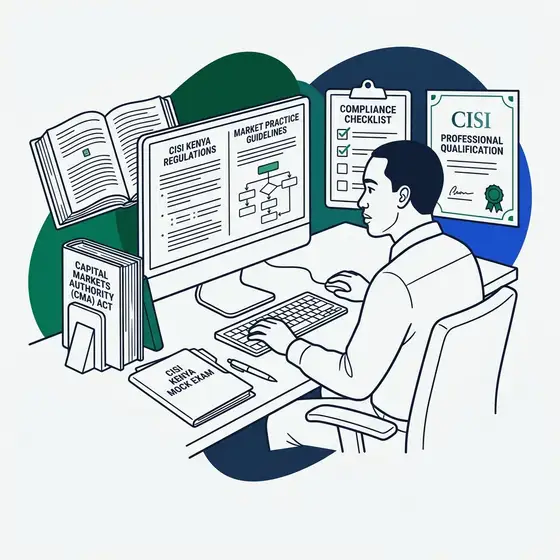
Best CISI Kenya Regulations & Market Practice Mock Exams & Free Sample Papers
Prepare for your CISI Kenya Regulations and Market Practice exam with our best mock exams and free sample papers, featuring hourly syllabus tracking.
CISI IISI Kenya Exam Guide: Format, Syllabus and Study Priorities
Prepare for CISI IISI Kenya Version 5 with the 60-question format, all ten syllabus areas, official weightings and an 80-hour study allocation.

Best CISI Corporate Finance Technical Foundations Mock Exams & Free Sample Papers
Prepare with the best CISI Corporate Finance Technical Foundations mock exams. Try our free sample paper, updated hourly from real student feedback, with 500+ questions.
Ready to Prepare for Your Exam?
Prepare with syllabus-aligned study tools, realistic practice and course-grounded AI support.
Explore Courses