
Table of Contents
- • Current edition update — September 2026
- • UKFR exam format at a glance
- • The four syllabus elements and their weightings
- - 1. The Regulatory Environment — 12 questions
- - 2. Conduct of Business and Client Assets — 35 questions
- - 3. Enhancing Market Integrity — 19 questions
- - 4. Complaints and Redress — 9 questions
- • An 80-hour UKFR study plan
- - Weeks 1–2: build the regulatory map
- - Weeks 3–5: prioritise conduct and client assets
- - Week 6: market integrity and complaints
- - Final week: timed performance
- • How to handle UKFR questions
- • Current-syllabus warning
- • Final checklist
CISI UK Financial Regulation
Explore syllabus-aligned study tools, realistic practice and course-grounded AI support.
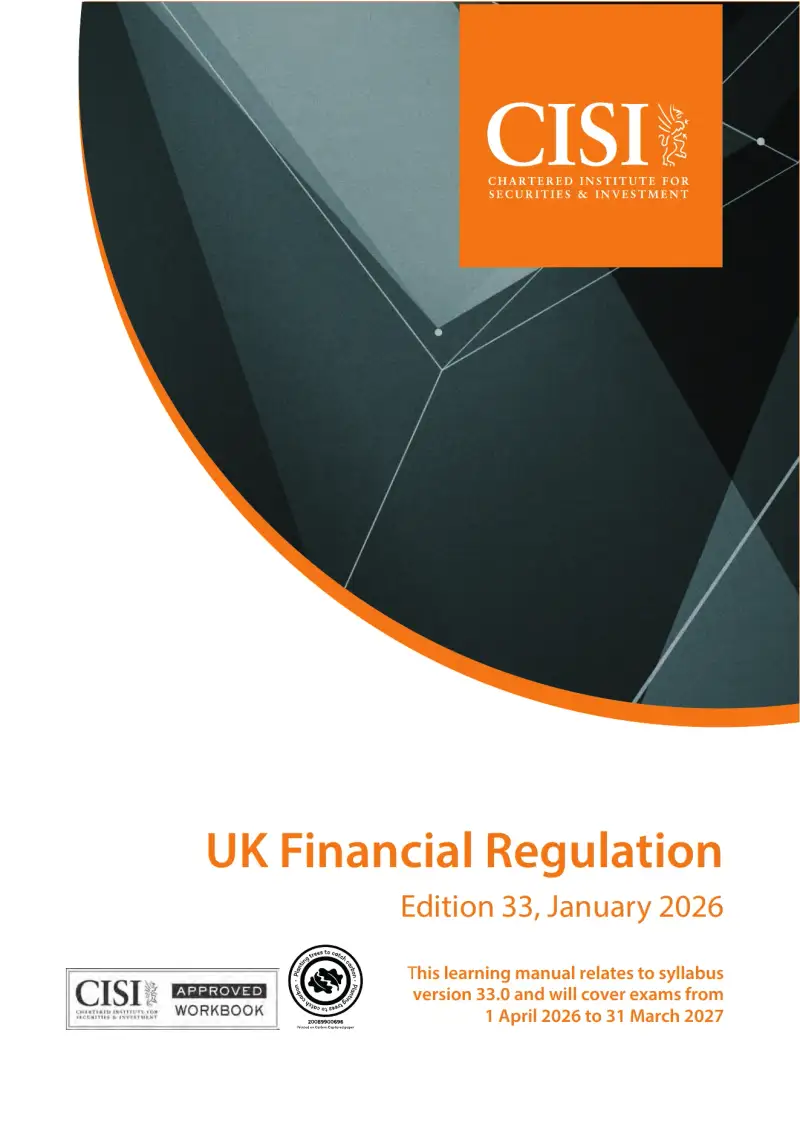
The CISI UK Financial Regulation (UKFR) exam tests whether you can apply the UK regulatory framework, not simply recite a list of rules. For Version 33, candidates answer 75 multiple-choice questions in 90 minutes, with a 70% pass mark. The learning manual recommends about 80 hours of study.
Quick answer: Build your revision around the official question weightings. Nearly half the exam sits in Conduct of Business and Client Assets, but the remaining marks are spread across regulation, market integrity, complaints and redress. A balanced plan is safer than trying to predict individual questions.
Current edition update — September 2026
The current source is Edition 33, digital workbook 33.1, with Version 33 applying from 1 April 2026 to 31 March 2027. The 15 April Candidate Update revises the COBS title and suitability wording, off-order-book reporting, the FSCS deposit limit and specified workbook answers. Our refresh also corrected the four-form market-manipulation taxonomy, the effect of an accepted FOS determination and the mapping of all 86 official objectives.
UKFR exam format at a glance
| Feature | Current detail |
|---|---|
| Qualification level | CISI Level 3 unit |
| Format | 75 multiple-choice questions |
| Duration | 90 minutes |
| Pass mark | 70% |
| Recommended study time | Approximately 80 hours |
| Current version | V33 |
| V33 exam window | 1 April 2026 to 31 March 2027 |
Ninety minutes gives an average of 72 seconds per question. That is enough time if your knowledge is secure, but not enough to reconstruct every rule from first principles. Your preparation therefore needs two layers: accurate recall and repeated application to short scenarios.
Free CISI UK Financial Regulation Practice Questions & Exam Preview
Try 15 CISI UK Financial Regulation practice questions from Element 2: Conduct of Business and Client Assets
Practice CISI UK Financial Regulation exam questions with answers and explanations. The full course includes 5 mock exams and chapter study tools.
Exam Preview
What should be established before applying a detailed COBS rule?
Flashcards
What should a UKFR candidate know about FCA strategic objective?
Focus Learn
- FCA and PRA roles, objectives and division of responsibility
- Principles for Businesses, Consumer Duty and cross-cutting rules
- SM&CR, Certification and the Fit and Proper Test
- FSMA general prohibition, regulated activities and exemptions
- UK regulatory infrastructure and international influences
- Authorisation, permissions, approved persons and appointed representatives
- Training and Competence, employee supervision, qualifications, SPS and CPD
- Industry and professional bodies, including the CISI Code of Conduct
The regulatory architecture
UK financial regulation begins with the Financial Services and Markets Act 2000 (FSMA). The Financial Conduct Authority (FCA) is the conduct regulator for financial markets and financial-services firms. Its strategic objective is to ensure that relevant markets function well; its operational objectives concern consumer protection, market integrity and effective competition. The Prudential Regulation Authority (PRA), part of the Bank of England, promotes the safety and soundness of the firms it supervises and contributes to the protection of insurance policyholders.
The Financial Policy Committee monitors risks to the UK financial system as a whole. HM Treasury sets government policy and the legislative framework, while the Bank of England also carries out m…
Unlock all Focus Learn
Open every element’s key areas, pitfalls, exam traps and key numbers.
The four syllabus elements and their weightings
| Syllabus element | Questions | Share of exam |
|---|---|---|
| The Regulatory Environment | 12 | 16% |
| Conduct of Business and Client Assets | 35 | 47% |
| Enhancing Market Integrity | 19 | 25% |
| Complaints and Redress | 9 | 12% |
| Total | 75 | 100% |
1. The Regulatory Environment — 12 questions
This element establishes the architecture behind the rules. You should be able to distinguish the responsibilities of the FCA, PRA and other bodies; understand regulated and prohibited activities; apply the Principles for Businesses; and recognise expectations relating to fitness, propriety, prudential standards, training and competence.
A common revision mistake is to memorise regulator names without learning why a particular firm, person or activity falls within a rule. Use short comparison tables: regulator, objective, firms affected and typical action.
2. Conduct of Business and Client Assets — 35 questions
This is the largest element and deserves the largest share of your study time. It includes client categorisation, financial promotions and communications, suitability and appropriateness, execution and reporting, custody assets and client money.
Learn the decision sequence rather than isolated definitions:
- What service or activity is the firm providing?
- What type of client is involved?
- Is suitability, appropriateness or neither required?
- What disclosure, consent, record or report follows?
- Are money or assets being protected under client-asset rules?
When two answer options look plausible, the correct distinction is often the service, client category or timing stated in the question.
3. Enhancing Market Integrity — 19 questions
This element covers market abuse, financial crime, money laundering, terrorist financing, sanctions, governance and reporting. Build a clear boundary between suspicious behaviour, a firm’s internal escalation, external reporting and the separate restrictions on tipping off.
For market conduct, compare the prohibited behaviours and the facts that establish each one. For financial crime, practise identifying the appropriate control at the correct stage: customer due diligence, ongoing monitoring, escalation, reporting or sanctions screening.
4. Complaints and Redress — 9 questions
Although this is the smallest element, nine marks can decide the result. Focus on complaint identification and handling, the Financial Ombudsman Service, the Financial Services Compensation Scheme, consumer rights, data protection and whistleblowing.
Create one process map from receipt of a complaint to final response and possible referral. Keep roles, eligibility and remedies separate; exams often test the difference between a firm’s obligation and a customer’s redress route.
An 80-hour UKFR study plan
The following allocation follows the exam weighting while preserving time for mixed practice.
| Activity | Hours |
|---|---|
| Regulatory Environment | 10 |
| Conduct of Business and Client Assets | 27 |
| Enhancing Market Integrity | 15 |
| Complaints and Redress | 7 |
| Element retrieval practice | 8 |
| Timed mixed questions and review | 9 |
| Final weak-area revision | 4 |
| Total | 80 |
Weeks 1–2: build the regulatory map
Read for structure before detail. At the end of each session, close the workbook and write down the regulators, rules and decisions you can recall. Check the gaps immediately. This is more effective than highlighting pages without testing memory.
Weeks 3–5: prioritise conduct and client assets
Spend almost half your content-study time here. Convert rules into client scenarios and compare concepts that are easy to confuse. Maintain a single error log with four fields: topic, your answer, why it was wrong and the rule that resolves it.
Week 6: market integrity and complaints
Use flowcharts for financial-crime escalation and complaints. Then mix questions across all four elements so you learn to switch between topics, as you must in the live exam.
Final week: timed performance
Complete timed sets at the real pace. Do not judge readiness from one familiar sample. Look for consistency across fresh questions and review every uncertain answer, including correct guesses.
How to handle UKFR questions
- Read the final sentence first so you know what decision is required.
- Mark qualifiers such as most appropriate, must, may, except and first.
- Identify the client, firm, service and stage of the process.
- Eliminate options that describe a true rule applied to the wrong situation.
- If stuck, choose your best answer, flag it and protect time for the remaining questions.
Current-syllabus warning
This guide was reviewed against UKFR Version 33 and the CISI update dated 15 April 2026. That update includes the current £120,000 FSCS deposit limit for relevant firm failures after 1 December 2025, revised suitability wording and clarification of off-order-book reporting. Regulatory wording can still change within an exam cycle, so check the official CISI candidate updates and the latest syllabus supplied for your exam date.
For structured revision linked to the four official elements, the CISI UK Financial Regulation course includes 375 practice questions across five full 75-question mock exams. It also includes 163 flashcards, 148 revision references, four detailed summaries and a syllabus-grounded AI tutor.
Final checklist
- Can you explain the roles of the FCA and PRA without looking at notes?
- Can you distinguish suitability from appropriateness in a scenario?
- Can you trace how client money or custody assets should be protected?
- Can you separate market-abuse concepts and financial-crime reporting duties?
- Can you map complaint handling, FOS and FSCS without mixing their roles?
- Can you complete 75 mixed questions within 90 minutes?
If any answer is no, you have found a revision priority. That is more valuable than rereading a comfortable element.
Frequently Asked Questions
1 How many questions are in the CISI UK Financial Regulation exam?
The current UKFR exam has 75 multiple-choice questions to be completed in 90 minutes.
2 What is the CISI UKFR pass mark?
The pass mark is 70%. The current official sample grading table equates this to 52 correct answers out of 75.
3 Which UKFR syllabus area has the most questions?
Conduct of Business and Client Assets is the largest element, with 35 of the 75 questions.
4 How long should I study for UK Financial Regulation?
The learning manual recommends approximately 80 hours. Candidates with less regulatory experience may need more time.
5 Which UKFR syllabus version applies in 2026?
Version 33 applies to exams from 1 April 2026 to 31 March 2027. Always check the latest CISI syllabus and candidate updates before your exam.
Keep learning
Related Insights

Saudi CME-1B (Formerly CISI SCMR) Exam Guide
Prepare for Saudi CME-1B, formerly known as CISI SCMR, with current exam facts, CMA rules, regulatory topics, study guidance, and practice questions.

CySEC Advanced Exam Guide: Format, Syllabus Weighting and Study Plan
Prepare for the CySEC Advanced exam with the current 70-question format, all 14 syllabus elements, official weighting and a practical study plan.

CySEC Basic Exam Guide: Format, Syllabus Weighting and Study Plan
Prepare for the CySEC Basic exam with the current 50-question format, all eight syllabus elements, official weighting and a practical revision plan.
Ready to Prepare for Your Exam?
Prepare with syllabus-aligned study tools, realistic practice and course-grounded AI support.
Explore Courses