
Table of Contents
- • Current exam structure
- • Ten syllabus elements and question weights
- • Start with equities, bonds and funds
- • Build the Kenya market context
- • Regulation, ethics and financial crime
- • Economics, derivatives and advice
- • An 80-hour allocation
- • IISI Kenya versus Kenya RMP
- • Use current, legitimate practice
- • Final checklist
CISI IISI Kenya
Explore syllabus-aligned study tools, realistic practice and course-grounded AI support.
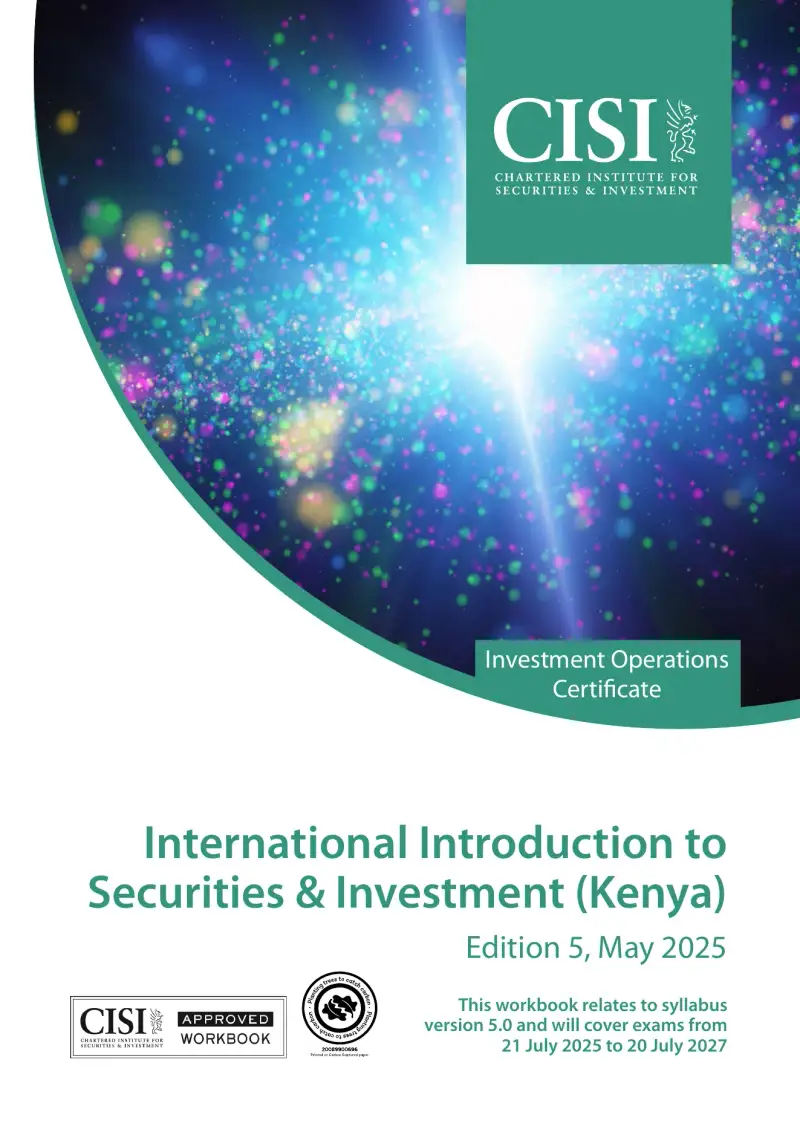
The CISI International Introduction to Securities & Investment (Kenya) gives candidates a broad foundation in markets, products, regulation and advice within the Kenya certification pathway.
Quick answer: Version 5 is assessed through 60 multiple-choice questions in 75 minutes. The pass mark is 70%, and the published syllabus divides the assessment across ten elements. Equities, bonds and investment funds account for 27 questions.
Current exam structure
| Item | Current detail |
|---|---|
| Qualification level | CISI Level 3 |
| Assessment | Multiple-choice examination |
| Questions | 60 |
| Duration | 75 minutes |
| Pass mark | 70% |
| Average pace | 75 seconds per question |
| Recommended preparation | Approximately 80 hours |
| Current syllabus | Version 5 |
| Exam window | 21 July 2025–20 July 2027 |
The 75-second average is enough for a prepared candidate, but not for repeatedly rereading definitions. Revision should therefore combine knowledge with fast comparison and application.
Ten syllabus elements and question weights
| Element | Questions | Share |
|---|---|---|
| Introduction | 5 | 8.3% |
| The Economic Environment | 4 | 6.7% |
| Equities/Stocks | 11 | 18.3% |
| Bonds | 8 | 13.3% |
| Other Markets and Investments | 5 | 8.3% |
| Derivatives | 4 | 6.7% |
| Investment Funds | 8 | 13.3% |
| Financial Services Regulation | 7 | 11.7% |
| Other Financial Products | 4 | 6.7% |
| Financial Advice | 4 | 6.7% |
| Total | 60 | 100% |
Start with equities, bonds and funds
Equities is the largest element. Candidates should connect company and share types with issuance, exchanges, trading, settlement, returns and risks. Avoid learning each topic in isolation: follow a share from issuance through the secondary market to settlement and ownership.
For bonds, build a consistent framework covering issuer, coupon, maturity, price, yield, credit quality and interest-rate sensitivity. For funds, compare open- and closed-ended structures, ETFs, alternative funds, dealing methods, costs and risks.
Build the Kenya market context
The course is not only a generic list of global instruments. The Kenya edition sits within the Securities Industry Certification Programme and expects candidates to understand the financial-services and regulatory setting relevant to the pathway.
Use Kenyan examples to make global concepts concrete, but keep the official learning objective in view. A Nairobi Securities Exchange example can help explain equity trading; it should not replace the wider principle that the exam is testing.
Regulation, ethics and financial crime
Financial Services Regulation carries seven questions. Connect regulatory objectives with professional integrity, financial crime, market conduct and the responsibilities of participants. Scenario practice is particularly useful here because a single fact can change whether conduct is suitable, misleading or prohibited.
Economics, derivatives and advice
The remaining elements are individually smaller but collectively represent more than half the paper. Economic conditions affect rates, currencies, bonds and equities. Derivatives connect hedging and speculation to futures, options, forwards and swaps. Advice then brings products back to client objectives, risk, liquidity and suitability.
A reliable revision method is to ask three questions for every product:
- How does it work?
- What return and risks does it create?
- For whom, or for what purpose, might it be suitable?
An 80-hour allocation
| Workstream | Hours |
|---|---|
| Introduction and economic environment | 10 |
| Equities | 13 |
| Bonds | 10 |
| Other markets and derivatives | 11 |
| Investment funds | 10 |
| Regulation and ethics | 9 |
| Other products and advice | 7 |
| Mixed practice, correction and mock exams | 10 |
| Total | 80 |
Do not allocate hours only by question count. A candidate working in equity operations may need less time on trade settlement and more on advice or protection products. Use a diagnostic set to adjust the plan.
IISI Kenya versus Kenya RMP
IISI Kenya is an introductory markets and products paper, while Kenya Regulations and Market Practice is a separate local regulatory unit. A role that names Kenya regulation may require RMP even after IISI; check the employer or licensing pathway instead of treating broader product knowledge as a substitution.
Use current, legitimate practice
Candidate discussions often ask for past papers. Old or unofficial questions can test superseded facts or use a different syllabus structure. Use the current syllabus as the coverage checklist, practise with original questions, and record why each error occurred: missing knowledge, misreading, calculation or application.
Review the official Version 5 syllabus and check the CISI candidate-update page before the exam.
The CISI IISI Kenya preparation page maps all 60 questions across the ten current elements.
Final checklist
- Confirm Version 5 still applies to your examination date.
- Know the question count for every element.
- Practise at approximately 75 seconds per question.
- Keep a structured error log.
- Complete mixed, unseen practice before the final week.
Frequently Asked Questions
1 What is the CISI IISI Kenya exam format?
The Version 5 assessment has 60 multiple-choice questions in 75 minutes, with a published pass mark of 70%.
2 Which syllabus areas carry the most questions?
Equities carries 11 questions, while Bonds and Investment Funds carry eight each. Together they account for 27 of the 60 questions.
3 Is IISI Kenya the same as Kenya Regulations and Market Practice?
No. IISI Kenya is the introductory investment paper. Kenya Regulations and Market Practice is a separate regulatory unit in the Kenya pathway.
4 Which syllabus version is current?
Version 5 applies to examinations from 21 July 2025 to 20 July 2027, subject to any later CISI candidate update.
5 How much study time should I plan?
Approximately 80 hours is a practical starting point. Reallocate time according to your background and diagnostic-question results.
Keep learning
Related Insights
CISI Asset Servicing Exam Guide: Chapters, Weightings and Study Plan
A current guide to the CISI Asset Servicing V22 exam, including its 50-question format, eight chapter weightings and an 80-hour revision plan.
CISI UK Financial Regulation Exam Guide: Syllabus and Study Plan
Prepare for CISI UK Financial Regulation V33 with the current exam format, element weightings, an 80-hour study plan and practical revision priorities.
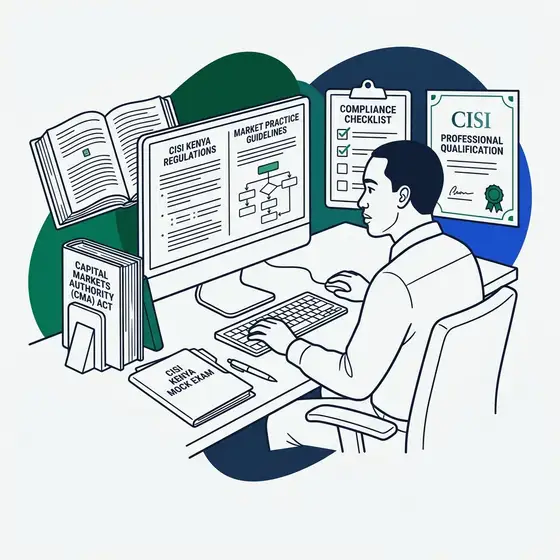
Best CISI Kenya Regulations & Market Practice Mock Exams & Free Sample Papers
Prepare for your CISI Kenya Regulations and Market Practice exam with our best mock exams and free sample papers, featuring hourly syllabus tracking.
Ready to Prepare for Your Exam?
Prepare with syllabus-aligned study tools, realistic practice and course-grounded AI support.
Explore Courses