
Table of Contents
ACAMS CAMS
Explore source-grounded summaries, flashcards, reference tools and realistic mock practice.

Quick answer: The current CAMS exam has 120 multiple-choice and multiple-selection questions, a 3.5-hour limit and a passing score of 75. Its four domains are weighted 30%, 20%, 30% and 20%.
The ACAMS CAMS exam tests whether you can connect financial-crime risk to proportionate controls and decisions. Memorising definitions matters, but many questions require you to distinguish a warning sign from evidence, a technology output from a final decision, or an international standard from the law that applies in a particular jurisdiction.
This guide follows the current official ACAMS CAMS certification information and four-domain candidate blueprint. Use ACAMS directly for eligibility, booking, examination delivery and policy questions.
What Is the Current CAMS Exam Format?
| Item | Current published detail |
|---|---|
| Questions | 120 |
| Question types | Multiple choice and multiple selection |
| Delivery | Computer-based, proctored examination |
| Duration | 3.5 hours / 210 minutes |
| Passing score | 75 |
| Guessing penalty | None |
The raw time budget is 105 seconds per question. That is enough only if recall questions are handled efficiently and the saved time is reserved for longer scenarios and multiple-selection items.
No guessing penalty means every question should receive an answer. It does not mean the best strategy is rapid guessing. First eliminate options that assign the wrong actor, confuse a red flag with proof, or apply a rule from the wrong jurisdiction. Then make the strongest evidence-based selection and move on.
How Are the Four CAMS Domains Weighted?
| Domain | Weight | Equivalent allocation in a 120-question mock |
|---|---|---|
| Understanding the Risks and Methods of Financial Crime | 30% | 36 |
| Global AFC Frameworks, Governance, and Regulations | 20% | 24 |
| Building an Anti-Financial Crime Compliance Program | 30% | 36 |
| Tools and Technologies to Fight Financial Crime | 20% | 24 |
The two 30% domains account for 72 questions in a proportionately weighted practice paper. They deserve the largest share of initial study time, but the 20% technology domain cannot be treated as an optional supplement. It examines how data, digital identity, screening, perpetual KYC, transaction monitoring, investigation tools and AI or machine learning are selected, governed and tested.
A useful revision plan begins with the official weighting, then adjusts according to mock evidence. If your second timed paper shows strong risk-method knowledge but recurring mistakes in technology governance, move time toward the weakness even though the domain is smaller.
What Does Each CAMS Domain Require?
Risks and methods covers money laundering, terrorist financing and related financial crimes across banking, non-bank services, virtual assets, trade, legal structures and other higher-risk sectors. Learn what creates the vulnerability and what information would confirm or reduce concern. A politically exposed person, complex company or cross-border transfer is not automatically suspicious.
Global frameworks and governance requires clear role separation. FATF sets international standards, while jurisdictions implement them through law and regulation. Regulators supervise; financial intelligence units receive and analyse reports; law-enforcement bodies investigate; courts determine legal outcomes. An exam option becomes weak when it silently transfers one actor’s authority to another.
Building an AFC compliance program connects risk appetite, enterprise risk assessment, policies, controls, customer due diligence, monitoring, investigations, reporting, training and assurance. Keep the three lines of defence distinct: the business owns and operates controls, the second line oversees and challenges, and internal audit provides independent assurance.
Tools and technologies is about effective and governable use, not merely buying software. A screening or monitoring system needs reliable input data, traceable configuration, validation, change control, human review, documented outcomes, privacy protection and a way to identify failures or drift.
Free ACAMS Certified Anti-Money Laundering Specialist (CAMS) Practice Questions & Exam Preview
Try 15 ACAMS Certified Anti-Money Laundering Specialist (CAMS) practice questions from Building an Anti-Financial Crime Compliance Program
Practice ACAMS Certified Anti-Money Laundering Specialist (CAMS) exam questions with answers and explanations. The full course includes 5 mock exams and complete syllabus coverage.
Exam Preview
Which CAMS knowledge point is defined or described by the following statement? Risk is dynamic and needs to be continuously managed, and the environment in which each organization operates is subject to continual change.
Flashcards
What is money laundering?
Focus Learn
- Definitions and relationships among AML, CFT, sanctions, fraud, bribery/corruption and tax evasion
- Placement, layering and integration without forcing every case into a rigid sequence
- Economic, social, operational, legal, reputational and concentration consequences
- Banking risks: transfers, correspondent banking, payable-through accounts, concentration accounts and private banking
- PEPs, high-risk customers, source of wealth/funds and structuring
- MSBs, PSPs, ecommerce, prepaid access, securities, insurance and virtual assets
- Casinos, real estate, high-value goods, gatekeepers, accountants and TCSPs
- Trade-based laundering, BMPE, corporate vehicles, trusts and beneficial ownership
- Terrorist-financing channels, informal value transfer systems and nonprofit organizations
Financial crime risk begins with the purpose and movement of value. Money laundering takes criminal proceeds and disguises their illegal source so the value can be used in apparently legitimate or further illegal activity. The familiar placement, layering and integration model remains useful: placement introduces criminal value into the financial system, layering creates distance and complexity, and integration returns the value in a form that appears legitimate. Real cases do not always follow a neat sequence, so the examiner may give facts that combine stages. Focus on what the transaction is doing: entering the system, obscuring the trail, or allowing apparently legitimate enjoyment of the proceeds.
The current CAMS domain is wider than money laundering alone. Counter-terrorist financi…
Unlock all Focus Learn
Open every chapter’s key areas, pitfalls, exam traps and key numbers.
How Should You Use the Official CAMS Flashcards?
The official printable deck supplied for this course contains 145 cards. Use them as an active-recall tool: read the question, answer aloud or in writing, then compare your response with the full answer. Mark a card as secure only when you can reproduce the distinction without prompts.
The deck keeps its original numbered sections, which predate the current four-domain presentation. Preserving that organization prevents newer labels from being presented as if they were part of the supplied official deck. Use the current-domain summaries, reference sheet, practice questions and AI tutor to cover updated Tools and Technologies objectives alongside the cards.
For long answers, split revision into three passes:
- Recall the central definition or decision rule.
- Add two or three representative examples or indicators.
- Explain the control response and the reason it is proportionate.
This produces usable exam knowledge instead of recognition alone.
A Six-Week CAMS Study Plan
| Week | Focus | Evidence of progress |
|---|---|---|
| 1 | Baseline test; risks, methods and sector vulnerabilities | Error log grouped by domain and misconception |
| 2 | Global frameworks, bodies and cross-border cooperation | Role-and-authority map recalled without notes |
| 3 | Governance, risk assessment and customer lifecycle | Control sequence explained from onboarding through exit |
| 4 | Monitoring, investigations, reporting and technology | Scenario answers that separate alert, evidence and decision |
| 5 | Two full timed mocks | Domain scores, timing data and repeated-error analysis |
| 6 | Weak-area repair and two final rehearsals | Stable scores above target under the 210-minute limit |
Use a four-step loop for every weak point: locate the source, state the rule from memory, apply it to a short scenario, and record why the rejected options fail. Re-reading without retrieval can feel productive while leaving selection skill unchanged.
What Are the Most Common CAMS Exam Traps?
- Red flag versus conclusion: unusual activity requires investigation and context; it is not proof of a crime.
- Standard versus law: FATF recommendations influence national systems but are not identical legal obligations everywhere.
- Alert versus match: a screening alert requires comparison, disposition and evidence before it becomes a confirmed match.
- Automation versus accountability: a model output supports a decision; qualified people and governance remain responsible for reliance.
- High risk versus prohibited: higher risk may justify enhanced due diligence, approval and monitoring rather than automatic rejection.
- Process versus effectiveness: completing a procedure does not prove that the underlying control is well designed or operating effectively.
During multiple-selection questions, test each statement separately before choosing a combination. A familiar statement can make an entire option look correct even when one included clause assigns the wrong authority or misses an exception.
Final CAMS Exam-Readiness Check
Before the examination, confirm that you can:
- explain the four domains and their relative weights;
- distinguish risk, indicator, evidence, escalation and final decision;
- map major international, regulatory, intelligence and enforcement bodies to their roles;
- follow a customer or alert through due diligence, monitoring, investigation and reporting;
- explain why data quality, validation, human review and change control matter to AFC technology; and
- complete a 120-question rehearsal within 210 minutes without leaving questions unanswered.
A strong CAMS plan is source-led, weighted and scenario-focused. Build precise recall with the supplied official flashcards, then use timed practice to prove that you can apply the knowledge across the current four-domain blueprint.
Frequently Asked Questions
1 What is the current ACAMS CAMS exam format?
The current CAMS candidate handbook describes a computer-based, proctored examination with 120 multiple-choice and multiple-selection questions. Candidates have 3.5 hours, or 210 minutes, to complete it.
2 What score is required to pass CAMS?
The current official handbook states that candidates must achieve a passing score of 75. It also states that there is no penalty for guessing.
3 How is the CAMS exam weighted?
The four domains carry weights of 30%, 20%, 30% and 20%. On a 120-question practice paper, that corresponds to a 36, 24, 36 and 24 question study allocation.
4 Are the course flashcards official ACAMS flashcards?
The course contains all 145 cards from the official printable ACAMS flashcard file supplied for this build, retaining the original card numbers. No generated cards are added to that official deck.
5 Is Exams Academy affiliated with ACAMS?
No. Exams Academy is an independent education provider and is not affiliated with or endorsed by ACAMS. Candidates should use ACAMS for official eligibility, scheduling and examination policies.
Keep learning
Related Insights

FATF, FIUs, Regulators and Law Enforcement: Who Does What?
Separate the roles of FATF, FIUs, regulators, law enforcement and courts so CAMS exam answers assign standards, intelligence and decisions correctly.
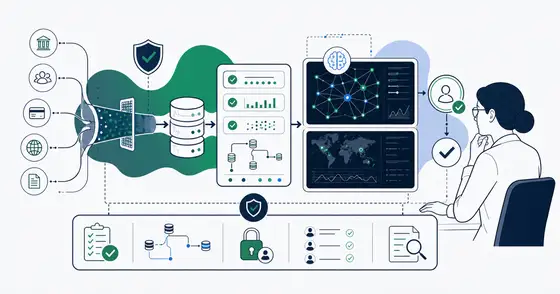
AML Technology, AI and Data Quality: CAMS Exam Guide
Learn how AML technology depends on data quality, validation, human review and accountable AI use across onboarding, screening and investigations.

Three Lines of Defence in AML: Roles and Exam Traps
Understand the three lines of defence in AML, who owns controls, how compliance challenges and why independent assurance must not test its own work.
Ready to Prepare for ACAMS CAMS?
Use source-grounded study tools and realistic practice to build accurate recall and exam-day confidence.
Explore Course Preparation