
Table of Contents
ACAMS CAMS
Explore source-grounded summaries, flashcards, reference tools and realistic mock practice.

Quick answer: An AML red flag is a warning indicator. Suspicious activity is a conclusion reached after the available context, customer profile, transactions, relationships and explanations have been assessed. A red flag starts the investigation; it does not finish it.
Confusing AML red flags vs suspicious activity creates two opposite failures. Treating every indicator as proof produces poor decisions, while waiting for one large alert can miss a pattern of linked low-value transfers that collectively supports concern. An innocent possible explanation should be tested, not assumed.
Red Flag, Unusual Activity and Suspicion
These terms describe different points in the decision process:
| Term | Practical meaning |
|---|---|
| Red flag | A fact or pattern that warrants closer review |
| Unusual activity | Behaviour that differs from the customer, product or peer expectation |
| Evidence | Verified information that supports or weakens an explanation |
| Suspicion | A reasoned conclusion under the applicable legal and internal test |
| Report | The confidential outcome of an authorised reporting decision |
An unexplained cross-border transfer may be a red flag. If the customer regularly pays an evidenced overseas supplier and the amount fits the business profile, the context may resolve the concern. If the documents conflict, counterparties are hidden and the payment route has no clear commercial purpose, concern may increase.
Why Context Matters More Than a Checklist
A checklist can identify patterns but cannot decide what they mean. The same behaviour can carry different risk in different circumstances.
- A cash deposit may fit one business and contradict another.
- A complex company may serve a legitimate commercial purpose or obscure ownership.
- A politically exposed person requires risk-sensitive treatment but is not automatically corrupt.
- A virtual-asset transfer may be transparent and expected, or it may create attribution and traceability concerns.
- A trade-price difference may have a commercial explanation or indicate misrepresentation.
The investigator should connect the indicator to the specific customer, product, jurisdiction, delivery channel, transaction and control weakness described.
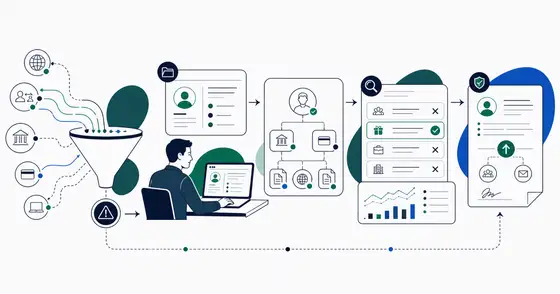
A Five-Step AML Red-Flag Review
- Define the trigger. State exactly what is unusual or inconsistent without using a crime label prematurely.
- Build the expected profile. Review identity, ownership, purpose, source information, expected activity and known relationships.
- Expand the connected activity. Examine linked accounts, counterparties, devices, locations, transactions and time periods relevant to the concern.
- Test explanations against evidence. A customer statement is an input; documents, transaction history and reliable external information help test it.
- Document and escalate. Record the scope, facts, analysis, unresolved concerns and decision according to the applicable process.
Free ACAMS Certified Anti-Money Laundering Specialist (CAMS) Practice Questions & Exam Preview
Try 15 ACAMS Certified Anti-Money Laundering Specialist (CAMS) practice questions from Building an Anti-Financial Crime Compliance Program
Practice ACAMS Certified Anti-Money Laundering Specialist (CAMS) exam questions with answers and explanations. The full course includes 5 mock exams and complete syllabus coverage.
Exam Preview
Which CAMS knowledge point is defined or described by the following statement? Risk is dynamic and needs to be continuously managed, and the environment in which each organization operates is subject to continual change.
Flashcards
What is money laundering?
Focus Learn
- Definitions and relationships among AML, CFT, sanctions, fraud, bribery/corruption and tax evasion
- Placement, layering and integration without forcing every case into a rigid sequence
- Economic, social, operational, legal, reputational and concentration consequences
- Banking risks: transfers, correspondent banking, payable-through accounts, concentration accounts and private banking
- PEPs, high-risk customers, source of wealth/funds and structuring
- MSBs, PSPs, ecommerce, prepaid access, securities, insurance and virtual assets
- Casinos, real estate, high-value goods, gatekeepers, accountants and TCSPs
- Trade-based laundering, BMPE, corporate vehicles, trusts and beneficial ownership
- Terrorist-financing channels, informal value transfer systems and nonprofit organizations
Financial crime risk begins with the purpose and movement of value. Money laundering takes criminal proceeds and disguises their illegal source so the value can be used in apparently legitimate or further illegal activity. The familiar placement, layering and integration model remains useful: placement introduces criminal value into the financial system, layering creates distance and complexity, and integration returns the value in a form that appears legitimate. Real cases do not always follow a neat sequence, so the examiner may give facts that combine stages. Focus on what the transaction is doing: entering the system, obscuring the trail, or allowing apparently legitimate enjoyment of the proceeds.
The current CAMS domain is wider than money laundering alone. Counter-terrorist financi…
Unlock all Focus Learn
Open every chapter’s key areas, pitfalls, exam traps and key numbers.
Common AML Red-Flag Examples
Official CAMS study material discusses indicators across many sectors. Useful categories include:
- rapid or repetitive transfers without clear economic purpose;
- structuring activity across amounts, people, accounts, locations or days;
- customer activity inconsistent with the stated occupation or business;
- opaque ownership, unexplained intermediaries or unnecessary layers;
- trade documents that conflict on goods, price, quantity, route or counterparty;
- payment, refund or surrender behaviour that does not fit the product’s normal use;
- use of several channels to fragment visibility; and
- adverse information that appears credible and relevant to the identified person.
None is an automatic reporting rule. Strong analysis explains why the indicator matters in the case and what evidence would confirm, reduce or redirect the concern.
What Makes an Investigation Defensible?
A defensible investigation is reproducible. Another qualified reviewer should be able to see:
- why the case was opened;
- which customers, accounts, transactions and periods were reviewed;
- what evidence was obtained;
- which explanations were tested;
- what remained unresolved;
- who approved the outcome; and
- how confidentiality was protected.
The decision record matters even when no report is filed. Closing a case without documenting why the indicator was resolved prevents later reviewers from understanding the logic and makes repeated behaviour harder to assess.
Mistakes CAMS Candidates Should Avoid
Red flag equals guilt: an indicator is a reason to investigate, not a criminal finding.
Unusual equals reportable: unusual behaviour may have an evidenced explanation. Apply the relevant reporting test.
One innocent fact clears everything: a plausible explanation for one transaction may not resolve a wider connected pattern.
More alerts means better control: alert volume does not prove effectiveness. Coverage, data, thresholds, investigation quality and outcomes must be assessed.
Customer contact without confidentiality controls: communications must not reveal protected reporting or investigation activity.
For the wider control sequence, continue with transaction-monitoring alert investigation and the current CAMS exam guide.
The Exam Decision Rule
In a CAMS scenario, prefer the answer that gathers relevant context, tests evidence, follows the correct authority and records a proportionate decision. Reject options that jump directly from an indicator to guilt, reporting or customer exit without applying the required process.
The central distinction is simple: red flags direct attention; evidence and analysis support decisions.
Frequently Asked Questions
1 Does an AML red flag prove money laundering?
No. A red flag is an indicator that justifies review and context gathering. It does not prove criminal activity and does not by itself determine whether a suspicious activity or transaction report is required.
2 What should an investigator do after finding a red flag?
The investigator should compare the activity with the customer profile, review connected parties and transactions, test plausible explanations, identify missing evidence and document the resulting decision.
3 Is unusual activity always suspicious?
No. Activity may be unusual because it differs from an expected pattern yet still have a reasonable, evidenced explanation. Suspicion depends on the complete facts and the applicable reporting test.
4 Can several weak indicators become important together?
Yes. Individually ordinary facts can form a meaningful pattern when combined across customers, accounts, counterparties, locations, products or time. Investigators should assess the connected behaviour rather than count indicators mechanically.
5 Who decides whether a report should be filed?
The decision should follow the organisation's approved escalation process and the legal test in the relevant jurisdiction. The investigator supplies documented analysis; the authorised reporting function makes and records the final decision.
Keep learning
Related Insights
Transaction Monitoring Alert Investigation: CAMS Workflow
Follow a transaction monitoring alert from detection through investigation, evidence, escalation and closure while avoiding alert-volume and automation traps.

FATF, FIUs, Regulators and Law Enforcement: Who Does What?
Separate the roles of FATF, FIUs, regulators, law enforcement and courts so CAMS exam answers assign standards, intelligence and decisions correctly.

AML Technology, AI and Data Quality: CAMS Exam Guide
Learn how AML technology depends on data quality, validation, human review and accountable AI use across onboarding, screening and investigations.
Ready to Prepare for ACAMS CAMS?
Use source-grounded study tools and realistic practice to build accurate recall and exam-day confidence.
Explore Course Preparation